
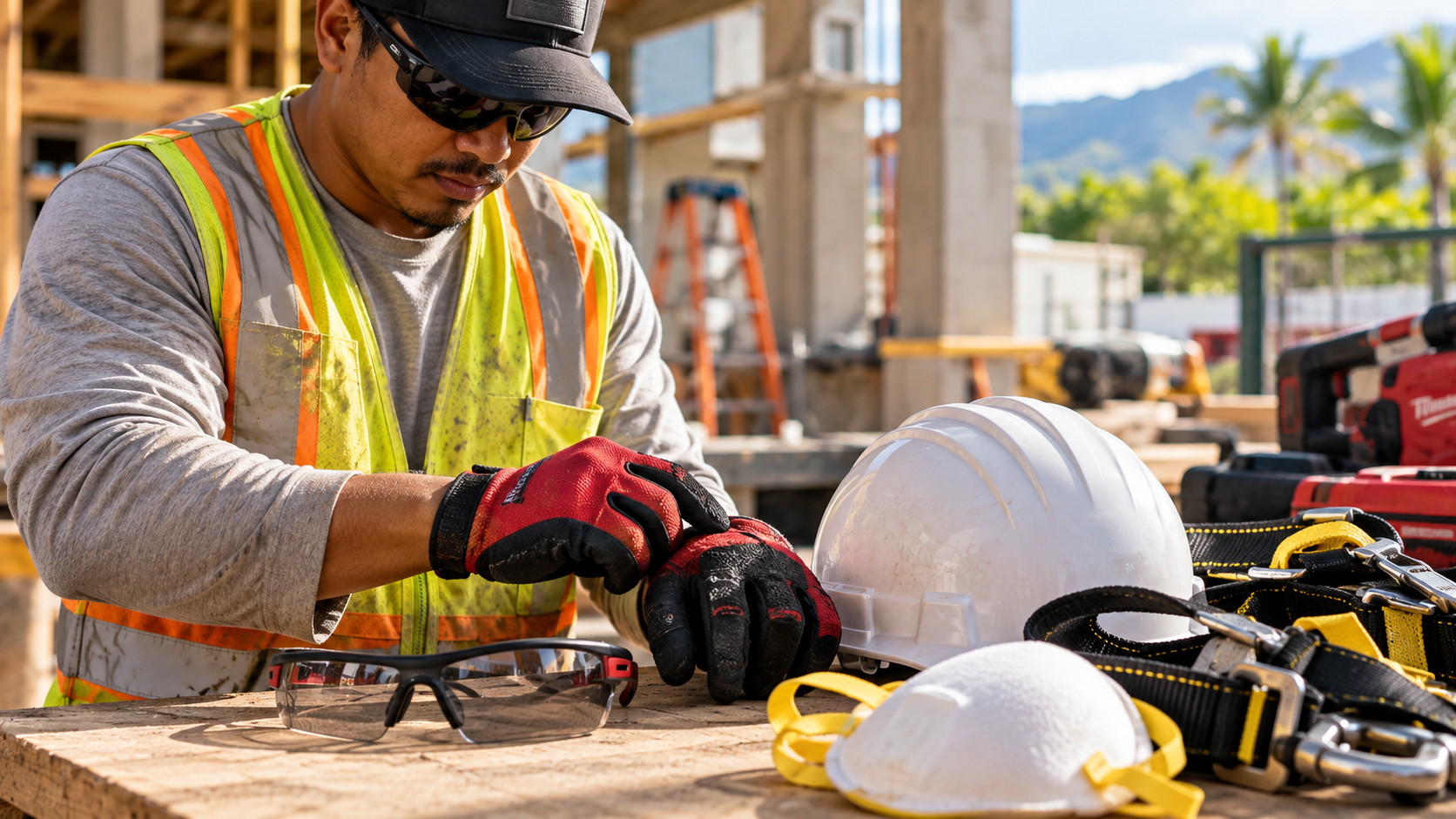
Working in Hawaiʻi brings challenges that can affect the safety equipment you choose. Heat and humidity can make protective gear uncomfortable during a long shift. Coastal conditions expose tools and hardware to moisture and salt. Construction work may also involve concrete dust, overhead hazards, or elevated work areas.
For contractors and tradespeople, the goal is to choose personal protective equipment (PPE) that matches the job's hazards while remaining practical to use throughout the workday.
At Slim's Power Tools, we carry safety equipment for professional tradespeople and DIY customers at our Honolulu and Kahului locations. Our selection includes fall protection, hard hats, safety glasses, work gloves, disposable N95 respirators, and other jobsite essentials.
Whether you're planning a construction project on Oʻahu, working on Maui, or researching safety equipment for a Big Island jobsite, this guide explains what to consider before choosing protective gear.
Why Hawaiʻi’s Working Conditions Matter When Choosing Safety Equipment
Safety equipment should be selected according to the hazards of the work, not simply the location of the project.
Hawaiʻi's climate adds practical considerations to that decision. Outdoor workers may experience heat exposure, high humidity, wet surfaces, and coastal conditions that affect equipment performance and maintenance.
Three factors deserve particular attention.
Heat and humidity
Protective equipment can contribute to heat strain, especially during physically demanding outdoor work.
A hard hat, gloves, and other required protection may affect how easily a worker can release body heat. Certain protective clothing and respiratory equipment can add to that burden.
The National Institute for Occupational Safety and Health (NIOSH) recommends managing occupational heat exposure through measures such as hydration, acclimatization, rest breaks, and appropriate work practices.
Cooling accessories can help with comfort, but they do not replace a workplace heat illness prevention plan.
We carry cooling towels, skull caps, and headbands among our safety equipment and PPE offerings.
Salt air and moisture
Coastal environments can accelerate corrosion of exposed metal components. Moisture may also affect the condition of equipment that is improperly stored.
For safety-critical equipment, corrosion is more than a cosmetic issue.
Metal connectors on fall protection equipment, for example, need to remain in the condition required by the manufacturer. Damaged components may compromise the equipment's intended performance.
Before choosing equipment for coastal work, consider:
- Whether the manufacturer identifies the product as suitable for the expected environment.
- How the equipment should be cleaned after exposure to moisture or salt.
- Which components require inspection before use.
- Whether the manufacturer specifies additional maintenance or storage precautions.
A product described as corrosion-resistant is not automatically suitable for every coastal application. The manufacturer's specifications and inspection criteria should guide the decision.
Dust and airborne contaminants
Construction activities such as concrete cutting, grinding, and demolition can create airborne dust.
Some work may involve respirable crystalline silica, which presents serious health risks when exposure is not adequately controlled.
Hawaiʻi Island also has volcanic hazards that may affect outdoor work. Volcanic ash and sulfur dioxide are different hazards, and they require different exposure-control decisions.
Respiratory protection should never be selected solely because a mask appears to provide a tight fit or is advertised for dusty conditions.
The appropriate protection depends on the substance, exposure level, working conditions, and applicable respiratory protection requirements.
Essential Safety Equipment for Construction and Trade Work
Not every job requires the same PPE. A carpenter operating a circular saw faces different hazards from a roofer working at height or a crew cutting concrete.
We recommend starting with the work being performed and the hazards identified in the jobsite assessment.
Here's how common safety equipment categories fit different tasks.
| Safety equipment | Common applications | What to consider |
|---|---|---|
| Hard hats and safety helmets | Construction areas with head injury hazards | Applicable helmet type, fit, condition, and manufacturer instructions |
| Safety glasses | Cutting, drilling, grinding, and tasks with flying particles | Appropriate impact protection, coverage, and anti-fog options |
| Work gloves | Material handling and tasks involving abrasion or cuts | Cut resistance, grip, fit, and compatibility with the task |
| Hearing protection | Work around saws, demolition equipment, and other loud machinery | Noise exposure, fit, and required attenuation |
| Fall protection | Roofing and elevated work with fall hazards | Anchorage, system compatibility, clearance, and training |
| Disposable N95 respirators | Certain particulate exposure situations | Exposure assessment, correct respirator selection, fit testing where required |
| Knee protection | Flooring, finishing, and other kneeling tasks | Cushioning, fit, and freedom of movement |
The equipment listed above is not a universal PPE checklist. Employers must assess workplace hazards and determine which protective measures are required.
Head and eye protection
Hard hats and safety helmets help protect against specified head injury hazards when correctly selected and used.
Different helmet designs offer different types of protection. Ventilation, accessory compatibility, and fit may also matter for workers spending long hours outdoors.
We carry full-brim and cap-style head protection, including options from LIFT Safety, ERB Safety, and Milwaukee.
For eye protection, we offer clear, smoke, mirrored, and anti-fog safety glasses.
Anti-fog options can be particularly useful when workers move between humid outdoor conditions and other environments where condensation affects visibility.
When selecting safety glasses, check the applicable impact rating and whether the task also requires side protection or additional face protection.
Work gloves and hearing protection
Work gloves should match the task rather than simply offer the highest available protection rating.
Cut-resistant gloves may be appropriate for handling sharp materials, while other tasks call for grip, dexterity, or abrasion resistance.
Our selection includes PIP MaxiFlex and MaxiCut gloves, along with Milwaukee work gloves in several styles.
For hearing protection, we carry earplugs and compatible hearing protection accessories.
Hearing protection needs depend on actual noise exposure. A comfortable pair of earplugs is useful only when it provides suitable protection and is worn correctly.
Fall protection for elevated work
Roofing and other elevated construction work require particular attention to fall hazards.
A complete fall protection system may include a harness, lanyard or self-retracting lifeline, and suitable anchorage. Each component must be compatible with the system and intended application.
Our fall protection category includes Safewaze harnesses, lanyards, self-retracting lifelines, anchors, roofing kits, and tool tethers.
Before choosing fall protection equipment, verify the applicable requirements for the work and consult the manufacturer's instructions.
Pay particular attention to anchorage suitability, fall clearance, inspection requirements, and worker training. A harness alone does not create a complete fall protection system.
The OSHA fall protection guidance provides additional information about workplace requirements.
Respiratory Protection for Construction Dust and Volcanic Conditions
Respiratory protection deserves its own discussion because different airborne hazards cannot be addressed with one universal mask.
Construction dust and silica
Concrete cutting, masonry drilling, and grinding can generate hazardous airborne particles.
The first priority is controlling exposure at the source through appropriate engineering and work-practice controls.
Depending on the task, these may include dust extraction, local exhaust ventilation, or water-based dust suppression.
We carry dust control and jobsite cleanup equipment, including dust shrouds, extractors, and wet/dry vacuums.
Not every vacuum or dust extractor is suitable for respirable crystalline silica control. Equipment selection should follow the applicable OSHA silica standard and the manufacturer's specifications.
Where respiratory protection is required, the employer must select appropriate equipment based on the exposure and comply with applicable respiratory protection program requirements.
For additional guidance, review OSHA's construction silica requirements.
Volcanic ash and vog on Hawaiʻi Island
Hawaiʻi Island workers may encounter volcanic ash or vog depending on volcanic activity, weather, and location.
These hazards should not be treated as interchangeable.
Volcanic ash contains particles that may irritate the respiratory system. Vog can contain sulfur dioxide gas and other pollutants.
An N95 respirator is designed to filter certain airborne particles. It does not protect against sulfur dioxide gas.
Respiratory protection for gas exposure requires a different assessment and potentially different equipment.
Our respiratory protection selection includes disposable N95 respirators from 3M and Milwaukee. We do not present these products as protection against volcanic gases.
For current volcanic conditions and hazard information, consult the USGS Hawaiian Volcano Observatory.
If volcanic emissions may affect your worksite, follow current official health and emergency guidance rather than relying on a general-purpose dust mask.
Understanding Hawaiʻi Workplace Safety Requirements
Hawaiʻi has its own occupational safety and health state plan, administered by the Hawaiʻi Occupational Safety and Health Division (HIOSH).
HIOSH oversees occupational safety and health requirements within its jurisdiction, while federal OSHA retains authority over certain workplaces and operations.
For employers, compliance begins with understanding the applicable standards and identifying the hazards employees face.
The HIOSH website provides state-specific regulatory information and resources.
Important areas to review may include:
- Personal protective equipment requirements.
- Fall protection standards.
- Respiratory protection requirements.
- Hazard communication.
- Occupational noise exposure.
- Construction-related silica exposure.
The specific rules depend on the work activity and the agency with jurisdiction.
Purchasing equipment with a particular label or rating does not, by itself, establish workplace compliance. Proper selection, training, use, and maintenance are also important.
What Customers Say About Slim’s Power Tools
When you’re choosing safety equipment for a jobsite, product selection is only part of the decision. You also want to know what it’s like to work with the supplier.
At Slim’s Power Tools, we encourage you to read customer reviews as you evaluate your options. Reviews can offer insight into other customers’ experiences with our team, our stores, and the process of finding tools and equipment for their work.
Read Steve B.‘s review of Slim’s Power Tools on YelpRead Lyn L.‘s review of Slim’s Power Tools on YelpRead Vance O.‘s review of Slim’s Power Tools on Yelp
For the published article, we recommend featuring two or three genuine customer reviews, with permission where required. Choose reviews that speak to helpful service, product knowledge, or the shopping experience. We haven't included quotations or ratings because those details need to come from verified customer feedback.
Get the Right Safety Equipment for Your Next Job
The right safety equipment helps your crew prepare for the hazards they may face, whether they’re working at height, handling materials, cutting concrete, or spending long hours outdoors.
At Slim’s Power Tools, we carry a range of jobsite safety products, including hard hats, safety glasses, work gloves, hearing protection, fall protection equipment, and disposable N95 respirators. We can help you explore available options so you can make an informed choice for your work.
Don't wait until you're on the jobsite to discover you're missing essential safety gear. Check what your crew needs before the next project begins, and contact us to confirm product availability.
Inventory varies by location, so we recommend calling ahead.
