
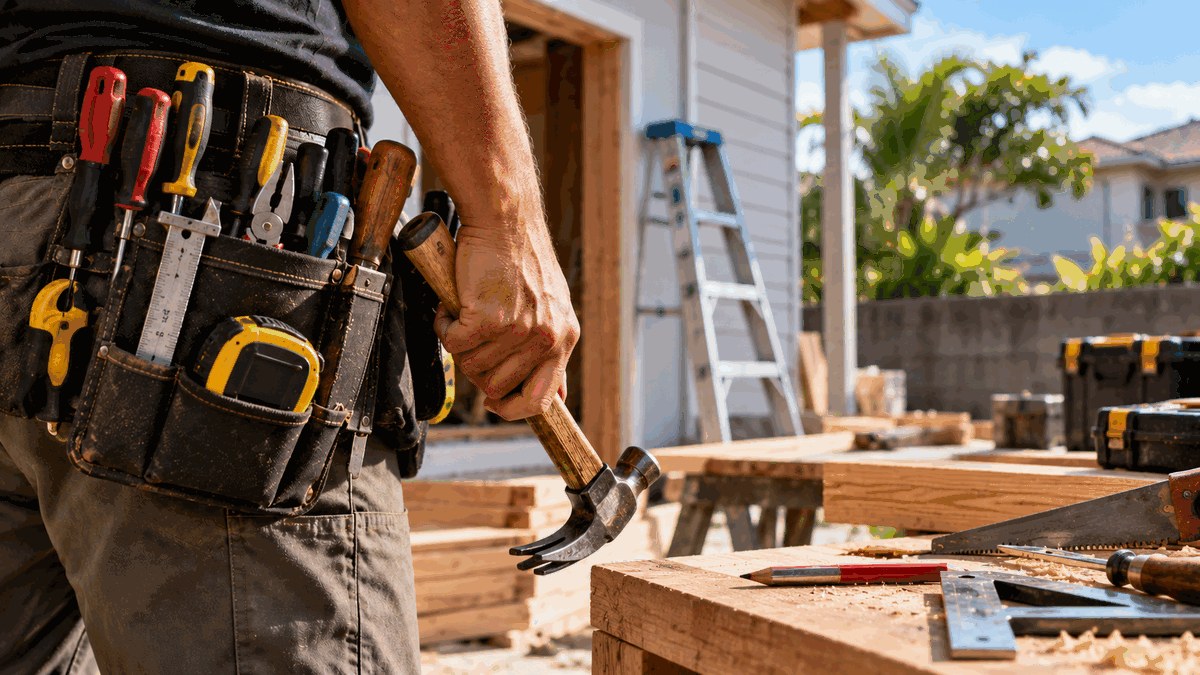
A cordless drill can drive dozens of screws in the time it takes to use a manual screwdriver. A circular saw cuts lumber faster than a handsaw. And a power sander can smooth a large surface without the effort of sanding by hand.
So why do professional contractors still carry hand tools?
Because getting the job done quickly isn’t always the same as getting it done correctly.
Sometimes you need to tighten a fastener without damaging the material around it. Other times, you’re working inside a cramped cabinet where a drill won’t fit. A sharp chisel, dependable wrench, or well-balanced hammer can give you the control needed to finish a job properly.
At Slim’s Power Tools, we supply both professional hand tools and powered equipment for contractors, tradespeople, and DIY customers in Hawaii. We understand that each has a place in a working toolkit.
Here’s why hand tools continue to matter, where they outperform powered equipment, and how to choose and use them effectively.
The Importance of Hand Tools in Modern Trade Work
Hand tools remain essential because they give users direct control over the force, movement, and pressure applied to a task.
That control is especially valuable when working with delicate materials, making small adjustments, or completing jobs where powered equipment would be impractical.
Greater Control for Precision Work
Power tools are designed to perform tasks efficiently, often at high speeds. That’s useful for drilling, cutting, and fastening, but it can also make small mistakes happen quickly.
Hand tools allow more deliberate movements.
For example, a carpenter fitting a wooden door may use a hand plane to remove a small amount of material from an uneven edge. A cabinetmaker might use a chisel to refine a joint after the initial cuts are complete.
Likewise, a manual screwdriver can provide useful tactile feedback when tightening small fasteners into delicate materials.
Precision still depends on skill and tool condition. A poorly sharpened chisel or incorrectly sized screwdriver can damage a workpiece just as easily as a power tool.
Convenience Without a Power Source
Hand tools don’t require batteries, charging equipment, extension cords, or compressed air.
That makes them useful for quick repairs, inspections, and adjustments.
A maintenance technician can tighten a loose fitting with a wrench without setting up additional equipment. An installer can make a small trim adjustment with a handsaw rather than retrieving a powered saw.
Hand tools are also useful backups when powered equipment is unavailable.
However, working without electricity doesn’t automatically make a task safe. Wet surfaces, unstable working positions, and nearby electrical hazards still require appropriate precautions.
Long-Term Practical Value
Many hand tools have relatively simple construction, making them practical to maintain over long periods.
A well-made wrench, hammer, or screwdriver can remain useful for years when properly selected, maintained, and stored.
Some tools also have replaceable handles, blades, or other serviceable components.
That doesn’t mean every hand tool lasts indefinitely. Cutting edges wear, handles crack, and moving parts can become damaged.
Still, choosing durable tools for frequently performed tasks can provide lasting value without relying on batteries or motors.
Hand Tools and Power Tools: Understanding the Difference
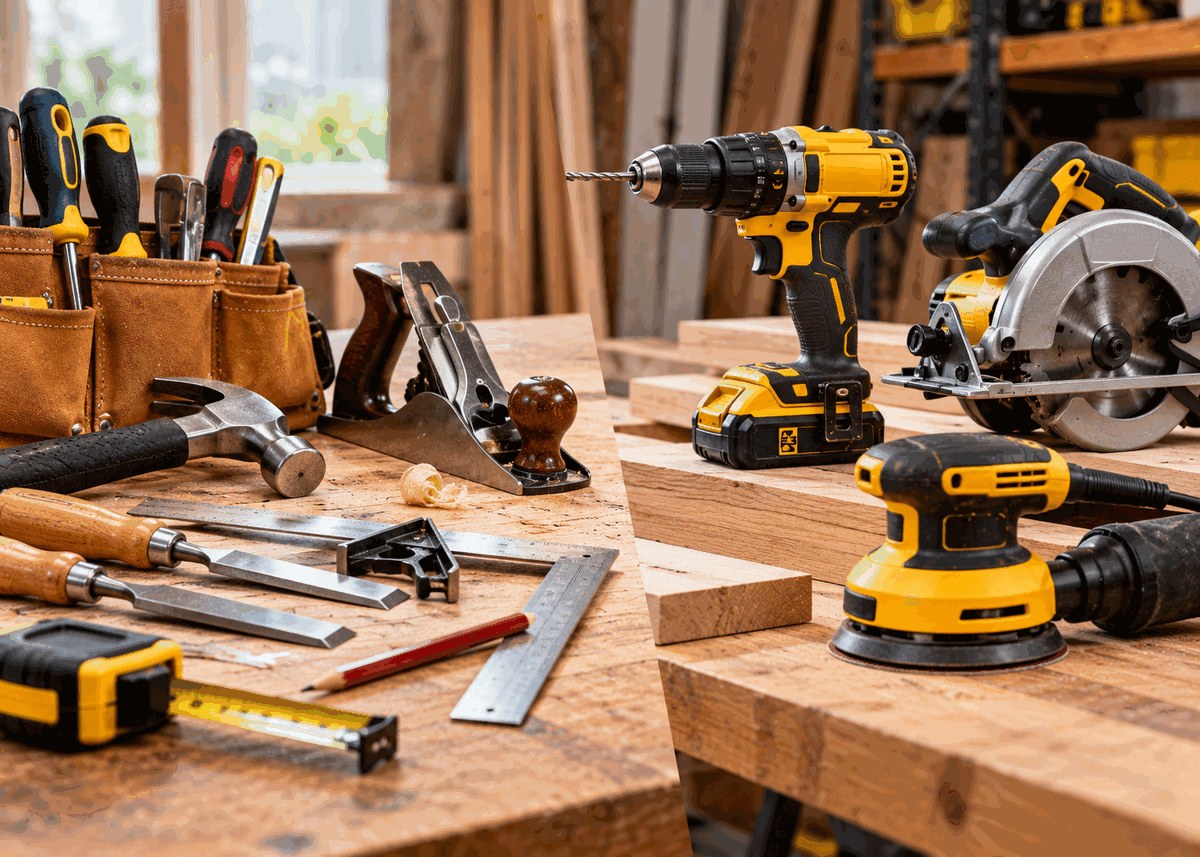
The main distinction between hand tools and power tools is how they operate.
Hand tools rely on human effort. Power tools use an external energy source, such as electricity, batteries, compressed air, or hydraulic power.
A hammer, chisel, wrench, and handsaw are hand tools. A cordless drill, angle grinder, and circular saw are power tools, even though they’re operated while being held.
Many traditional hand tools also use the principles of simple machines.
A claw hammer works as a lever when pulling nails. A chisel functions as a wedge when cutting material. Pliers use leverage to increase gripping force.
Understanding these principles helps explain why simple tools can perform demanding tasks effectively.
Comparing Performance and Practicality
| Consideration | Hand Tools | Power Tools |
|---|---|---|
| Speed | Better suited to small or deliberate tasks | Generally faster for repetitive work |
| Precision | Direct tactile control | Efficient, but requires appropriate setup and technique |
| Physical effort | Usually requires more manual effort | Often reduces effort during demanding operations |
| Power source | Human effort | Electricity, batteries, air, or other energy |
| Maintenance | Typically simpler, depending on the tool | May involve motors, electronics, or mechanical assemblies |
| Noise | Often quieter | Can produce substantial noise |
| Best applications | Adjustments, fitting, finishing, small repairs | Heavy cutting, drilling, grinding, repeated fastening |
Neither category is universally better.
A professional toolkit should support the different stages of a job rather than depend entirely on one type of equipment.
Essential Hand Tools and Their Everyday Applications
Although every trade has different requirements, several hand tools remain useful across construction, maintenance, woodworking, and mechanical work.
| Hand Tool | Primary Function | Typical Application |
|---|---|---|
| Hammer | Striking and nail removal | Framing and general carpentry |
| Screwdriver | Driving and removing screws | Installation and equipment maintenance |
| Pliers | Gripping, bending, and cutting | Electrical and mechanical work |
| Wrenches | Turning nuts and bolts | Plumbing and equipment assembly |
| Handsaw | Cutting wood manually | Trim work and small cuts |
| Chisel | Cutting and shaping material | Woodworking and joinery |
| Utility knife | Scoring and trimming | Drywall, packaging, and sheet materials |
| Tape measure | Measuring dimensions | Construction layout |
| Level and square | Checking alignment and angles | Framing and installation |
| Clamp | Securing workpieces | Assembly, cutting, and glue-ups |
These tools are most effective when selected for their intended applications.
For instance, a combination square is useful for checking right angles and marking reference lines, while a level helps establish horizontal or vertical alignment.
Similarly, pliers designed for gripping aren’t always suitable for cutting wire, and a standard screwdriver should never be used as a substitute for a pry bar.
Using the correct tool improves efficiency and helps reduce unnecessary damage.
For a more detailed discussion of building a traditional toolkit, our separate Classic Hand Tools guide covers starter-tool selection, Japanese designs, and vintage-versus-modern options.
The Advantages of Combining Hand Tools and Power Tools
One of the most practical approaches to professional work is using powered equipment for demanding operations and hand tools for tasks requiring additional control.
This combination helps balance productivity, accuracy, and physical effort.
Woodworking and Finish Carpentry
A carpenter might use a circular saw to cut lumber to approximate dimensions, then finish the fit with a hand plane or chisel.
The powered saw handles the bulk cutting efficiently, while the hand tool allows controlled adjustments.
Japanese pull saws are another useful option for detailed woodworking.
These saws generally cut on the pull stroke, allowing many designs to use thin blades that produce narrow cuts.
At Slim’s, our Japanese hand tool selection includes pull saws, replacement blades, and other tools for cutting and layout work.
Electrical and Mechanical Maintenance
Powered drivers make repetitive fastening faster, but manual screwdrivers remain useful when working with delicate components or limited clearance.
Mechanics also rely on manual wrenches and sockets for controlled adjustments and situations where powered equipment is unnecessary.
For electrical work, the correct tool rating matters. Ordinary hand tools should never be assumed suitable for energized equipment.
Use properly rated equipment and follow applicable electrical safety procedures.
Construction and Installation
On construction sites, powered equipment handles demanding tasks such as drilling concrete, cutting framing materials, and fastening large quantities of hardware.
Hand tools remain important for layout, alignment, adjustments, and finishing.
A tape measure and square help establish accurate dimensions before cutting begins. A hammer or pry bar can assist with suitable positioning and removal tasks.
The most efficient approach is to choose equipment according to the operation, material, and working conditions.
Choosing Durable Hand Tools for Professional Use
A hand tool doesn’t need to be the most expensive option to perform well. It needs to be appropriate for the task, comfortable to use, and constructed to withstand its intended working conditions.
Materials and Construction
Tool materials influence durability and performance.
Chrome-vanadium steel is commonly used in many wrenches and sockets, while specialized cutting tools may use different steels selected for hardness and edge retention.
However, material names alone don’t establish quality.
Heat treatment, manufacturing tolerances, and overall construction also affect how a tool performs.
For striking tools, check that the head and handle are securely assembled. For pliers and wrenches, examine jaw alignment and movement.
Measuring tools should provide consistent, readable markings and accurate reference surfaces.
Comfort and Ergonomics
A tool that feels uncomfortable during a brief inspection may become difficult to use over an entire workday.
Consider handle shape, grip texture, balance, and overall size.
A screwdriver handle should provide sufficient control without requiring excessive grip force. Pliers should open and close smoothly, with handles suited to the user’s hand size.
For frequently used equipment, comfort can be just as important as material specifications.
Matching Tools to the Trade
Different professionals need different equipment.
Woodworkers often prioritize saws, chisels, planes, and layout tools. Mechanics depend on wrenches, sockets, pliers, and specialized fastening tools.
Electricians require appropriate cutters, wire strippers, screwdrivers, and other equipment suited to electrical work.
Construction crews may rely more heavily on hammers, utility knives, measuring tools, and pry bars.
Start with the tools you use regularly, then expand your collection as your work requires.
More Than Power Tools: What Slim’s Carries
At Slim’s Power Tools, we supply equipment for a wide range of professional applications.
Our selection includes manual tools as well as the powered equipment that complements them.
Relevant categories include:
- Professional hand tools: Wrenches, pliers, screwdrivers, hammers, and other tools for construction, installation, and maintenance.
- Japanese hand tools: Pull saws, replacement blades, utility knives, and layout tools for specialized cutting and measuring tasks.
- Professional power tools: Drills, saws, grinders, and fastening equipment for demanding applications.
- Chemicals and lubricants: Selected products for appropriate maintenance and equipment-care applications.
Our team can help customers compare suitable tools, understand compatibility considerations, and discuss special-order options for eligible products.
Product selection and availability may vary by location.
Why Choose Slim’s Power Tools
Choosing equipment is easier when you can discuss the work with someone familiar with professional tools.
At Slim’s, we focus on heavy-duty power tools, hand tools, and contractor supplies.
We help customers compare products based on their intended applications rather than simply choosing the most powerful or expensive option.
For someone building a professional toolkit, that means considering both manual and powered equipment.
A contractor may need a durable set of hand tools alongside a cordless drill platform. A woodworker may benefit from a specialized handsaw as well as powered cutting equipment.
With local store access in Honolulu and Kahului, customers can speak with our team directly and inspect available products before purchasing.
We also offer special-order assistance for eligible equipment when the required product isn’t available at the counter.
Our goal is to help you find tools that make sense for the work you do.
Frequently Asked Questions About Hand Tools
Why are hand tools still important when power tools are available?
Hand tools provide direct control, require no external power source, and are useful for detailed work, adjustments, and small repairs. They complement powered equipment rather than replace it.
Are hand tools safer than power tools?
Not automatically. Hand tools avoid some motor-related hazards but can still cause cuts, impact injuries, and strains. Safety depends on proper selection, maintenance, technique, and protective equipment.
Are hand tools considered machines?
Many hand tools operate using the principles of simple machines, such as levers and wedges. However, in everyday tool classifications, manually operated tools are generally distinguished from externally powered equipment.
What are the disadvantages of using hand tools?
Hand tools can be slower for repetitive work and may require greater physical effort. Extended use can also contribute to fatigue. Powered equipment is often more practical for heavy drilling, large-scale cutting, and repeated fastening.
Which hand tools should a contractor buy first?
Start with the tools required for your trade. Common essentials include measuring tools, a hammer, screwdrivers, pliers, wrenches, and suitable cutting tools. Choose specialized equipment based on your regular tasks.
How can I keep hand tools in good condition in Hawaii?
Clean and dry them after use, inspect for damage, protect suitable metal surfaces against corrosion, and store them away from moisture. Maintain cutting edges and replace damaged components as needed.
Equip Your Toolkit With Slim’s Power Tools
Hand tools remain essential because they provide something every professional needs: control over the work.
From careful adjustments to everyday maintenance, the right manual tools help you complete tasks that don’t always require a motor.
And when a job calls for speed or greater cutting power, having suitable powered equipment alongside your hand tools gives you more flexibility.
At Slim’s Power Tools, we’re here to help you build a practical toolkit for your trade.
Honolulu, Oahu
1626 Republican St., Honolulu, HI 96819
(808) 841-0902
Kahului, Maui
142 Kalepa Place, Kahului, HI 96732
(808) 242-7878
Tell us about the projects you’re working on, and we’ll help you explore hand tools, power tools, and accessories suited to your needs.
Contact Slim’s Power Tools today and find the right equipment for your next job.
