
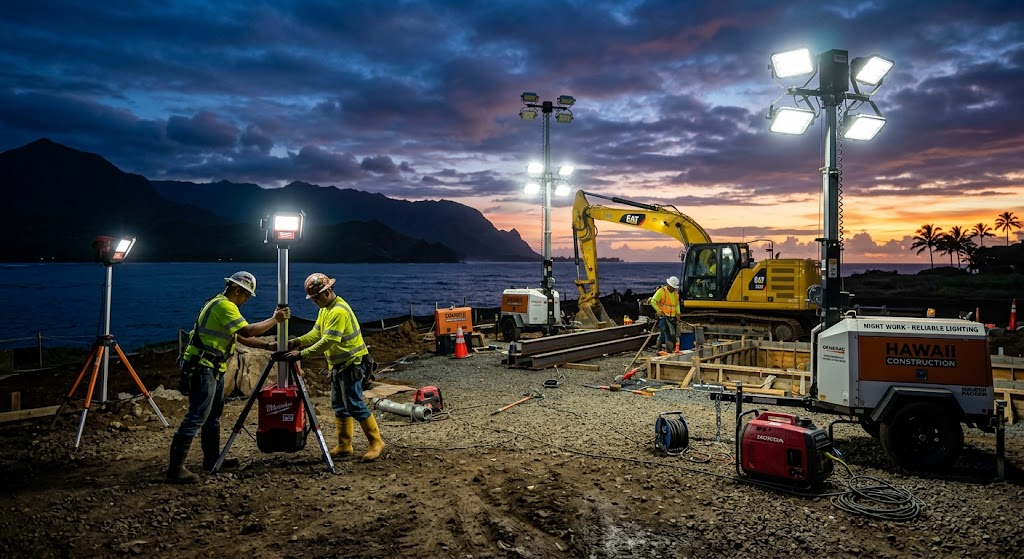
Hawaii construction rarely waits for perfect daylight. Early pours, night concrete work, interior fit-outs, and coastal sites with limited fixed lighting all demand portable setups that hold up under humidity, salt air, and volcanic dust. Poor lighting slows production, raises trip-and-fall risk, and can leave crews working below recommended illumination levels.
This guide covers the practical decisions contractors face when choosing and deploying jobsite lights: lumen needs, LED versus older technology, battery versus corded power, mounting options, weather resistance, glare control, setup speed, and generator load. We also show how Slim’s Power Tools supports these choices with local inventory of professional work lights, compatible batteries, generators, and related jobsite equipment on Oahu and Maui.
What Illumination Levels Do You Actually Need?
OSHA 29 CFR 1926.56 sets minimum illumination for construction areas while work is in progress. Common targets include approximately 3 foot-candles for general construction, excavation, and concrete placement areas; 5 foot-candles for indoor corridors, warehouses, and general construction lighting; and higher levels (10–30 foot-candles) for shops, first-aid stations, and detailed tasks.
These are minimums. Dust, distance from the fixture, lamp aging, and shadow from forms or scaffolding often require higher output in practice. Measure with a light meter when possible, or start with manufacturer-stated lumen ratings and adjust based on coverage area and mounting height.
For Hawaii sites, factor in rapid dusk, frequent early starts, and interiors that stay dim even at midday. Aim for even coverage rather than a few high-intensity spots that create deep shadows.
LED Versus Older Technology
Modern portable work lights are almost entirely LED. Compared with halogen or older high-intensity discharge lamps, LEDs deliver more usable light per watt, run cooler, resist vibration better, and last far longer under daily transport and setup. They also maintain output more consistently as they age.
Older technology still appears on some legacy towers, but replacement costs, heat, and fragility make it less practical for daily contractor use. When evaluating LED units, look at actual lumen output, beam pattern (flood versus spot), color temperature (cooler white often improves visibility for detail work), and IP rating for dust and water resistance.
Battery Versus Corded Power
| Factor | Battery-Powered Lights | Corded Lights |
|---|---|---|
| Mobility | High – no extension cord limits | Limited by available power and cord length |
| Runtime | Depends on battery capacity and output setting | Continuous while powered |
| Setup speed | Fast – no cords to route | Requires power source and safe cord management |
| Best for | Remote areas, quick tasks, multiple small zones | Long-duration work near temporary power or generators |
| Hawaii considerations | Ideal for early starts before temp power is ready; salt air favors sealed battery packs | Useful for extended night pours once generators are running |
Many crews run a mix. Cordless lights from platforms such as Milwaukee M18, DEWALT 20V MAX/FLEXVOLT, Makita, and Metabo HPT let you light the first tasks of the day or remote areas without waiting for generators. Corded or high-output tower lights handle sustained coverage once temporary power is available.
Slim’s Power Tools stocks portable work lights from Scangrip, Milwaukee, DEWALT, Makita, Metabo HPT, and related brands in handheld, flood, spot, and tower styles. We also carry the batteries and chargers that keep those lights running on the platforms many crews already own.
Tripod, Mounted, and Handheld Options
- Tripod lights give height and broad coverage for open areas, formwork, and pathways. Look for stable bases that resist wind and quick-deploy legs.
- Magnetic or clamp-mounted lights work well on steel, scaffolding, and equipment.
- Handheld and inspection lights handle close-up tasks, confined spaces, and walk-around checks.
For early starts and night work, a combination of one or two elevated floodlights plus several cordless handhelds usually covers both area lighting and task lighting without excessive setup time.
Weather Resistance and Hawaii Conditions
Coastal salt air, high humidity, and volcanic aggregate dust punish electronics. Choose lights with solid IP ratings (IP54 or higher is common for professional portable units) and sealed battery compartments. Avoid leaving lights uncovered overnight when possible. After coastal or dusty days, wipe down housings and check seals.
Generators used to power larger lights also need protection from the same conditions. Slim’s carries portable generators from Honda and Benner Nawman suitable for jobsite use, along with heavy-duty extension cords and power distribution products. Always operate generators outdoors with proper exhaust clearance.
Glare, Setup Speed, and Power Draw
Glare reduces visibility and increases eye strain. Position lights to the side of the work zone rather than directly in workers’ line of sight. Diffused or adjustable-beam heads help. Some LED units offer multiple brightness settings so you can drop output once the area is established.
Setup speed matters when crews arrive before sunrise. Prefer lights with quick-release stands, tool-free adjustments, and battery platforms already in use on the site. Avoid systems that require special tools or long warm-up times.
Power draw affects generator sizing. Add the running watts of all lights plus tools that will operate simultaneously, then include starting surge for any motors. Undersized temporary power leads to nuisance trips and reduced light output.
Why Local Inventory Matters More Than Online Photos
Big-box stores and pure online retailers can show attractive product pages, but they rarely stock the depth of professional lighting and supporting equipment that Hawaii contractors need on short notice. When a light fails mid-pour or a battery pack dies before a night shift, waiting for mainland shipping costs schedule time.
At Slim’s we maintain a local inventory of jobsite lights, compatible batteries and chargers, generators, extension cords, and related supplies at both our Honolulu and Kahului locations. Crews can often replace failed units the same day. Our staff works with professional platforms daily and can help match output, runtime, and mounting to the specific work you have planned.
We also stock safety equipment that pairs directly with better lighting: high-visibility gear, hard hats with accessory mounts, and related PPE. Join the Slim’s e-Power Club for alerts on lighting and battery promotions before they reach the general public.
Relevant products and services we offer for jobsite lighting setups:
- Portable work lights (handheld, flood, spot, tower) from Scangrip, Milwaukee, DEWALT, Makita, Metabo HPT and other professional lines
- Compatible batteries and chargers across major platforms
- Portable generators (Honda, Benner Nawman) and heavy-duty extension cords
- Jobsite equipment and specialty items for temporary power and visibility
- Safety equipment that supports night and low-light work
- Repair support and the unconditional one-year guarantee on qualifying DEWALT, Milwaukee, and Metabo HPT power tools
How Slim’s Differs from Big-Box and Online-Only Options
Big-box inventory prioritizes high-turnover consumer items. Staff training is often limited. Online-only sellers add shipping time and return friction for heavy or bulky lighting gear. Slim’s has operated as a specialized Hawaii tool house since 1972 (Maui since 1993). We focus on professional-grade tools and supplies, keep deep local stock on Oahu and Maui, offer repair and sharpening services, and provide an unconditional one-year guarantee on select DEWALT, Milwaukee, and Metabo HPT tools. That combination matters when lighting is part of a larger jobsite system that must stay productive under island conditions.
Frequently Asked Questions
What lumen output should I target for general jobsite area lighting?
Start from OSHA minimums (roughly 3–5 foot-candles for many construction areas) and increase based on mounting height, coverage area, and site conditions. Manufacturer lumen ratings help comparison, but real-world measurement or experience on similar sites is the practical check.
Are battery lights powerful enough for night concrete pours?
High-output cordless flood and tower lights can handle many tasks, especially when multiple units are used. For large open areas or very long durations, pair them with generator-powered lights once temporary power is available.
How do I protect lights from salt air and humidity?
Choose units with higher IP ratings, store them dry when not in use, wipe down after coastal exposure, and inspect seals regularly. The same care applies to generators and extension cords.
Can I use my existing Milwaukee, DEWALT, or Metabo HPT batteries on Slim’s work lights?
Many of the lights we stock run on those platforms. Bring your battery model or tool when you visit so we can confirm compatibility and available light options.
Do you carry generators sized for multiple work lights plus tools?
Yes. We stock portable generators from Honda and Benner Nawman. Calculate total running and starting watts for the lights and tools you plan to run together, then check current inventory at the Honolulu or Kahului store.
What if a light fails on the job?
Call the nearest Slim’s location. Local inventory often allows same-day replacement of common professional work lights and batteries. Qualifying DEWALT, Milwaukee, and Metabo HPT tools may also be covered under our unconditional one-year guarantee.
Reliable jobsite lighting is not a luxury for crews working before dawn or after dusk in Hawaii. It is a core part of safe, productive work. Stop by Slim’s Power Tools in Honolulu or Kahului, tell us the type of work and the power platforms you already use, and we will help you put together a practical lighting package that matches the conditions on your sites.
Visit us, call ahead for specific models, or join the e-Power Club for promotion alerts. We are here to keep your crews working with the visibility they need.
