
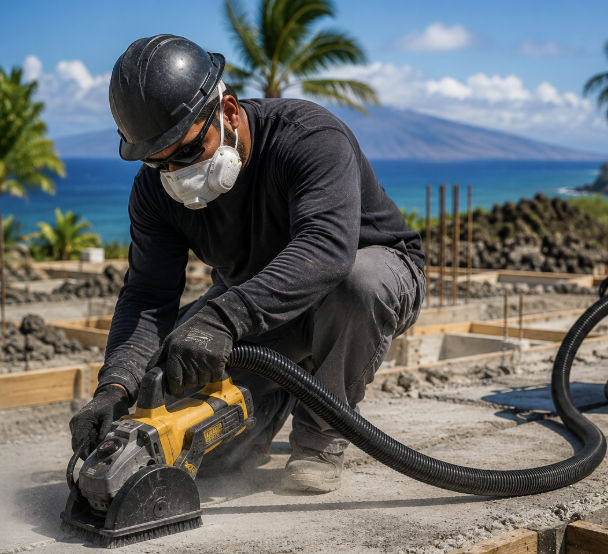
Hawaii contractors deal with conditions that mainland crews rarely face in the same combination. Dense volcanic aggregate, persistent humidity, and salt-laden air all affect how dust behaves and how equipment holds up. When crews cut, grind, drill, chip, or demolish concrete, brick, block, or masonry, they generate respirable crystalline silica. These particles are small enough to reach deep into the lungs. Long-term exposure can lead to silicosis, lung cancer, chronic obstructive pulmonary disease, and other serious health problems.
OSHA’s silica standard for construction, 29 CFR 1926.1153, sets a permissible exposure limit of 50 micrograms of respirable crystalline silica per cubic meter of air averaged over an eight-hour shift. The rule prioritizes engineering controls over respirators. Dust extraction systems that capture particles at the source remain one of the most practical ways for contractors to stay compliant while keeping work moving on Oahu and Maui jobsites.
Understanding OSHA Requirements for Dust Collection
The standard gives employers two main paths. They can follow the specified exposure control methods listed in Table 1 for common construction tasks, or they can perform exposure assessments and implement alternative controls that keep levels at or below the permissible exposure limit. Most contractors prefer Table 1 because it provides clear, task-specific guidance and reduces the need for frequent air monitoring when the listed controls are used correctly.
For many power-tool tasks, Table 1 calls for a commercially available dust collection system. The system must deliver the airflow recommended by the tool manufacturer or greater. The filter must achieve 99 percent or greater efficiency. Certain applications also require a filter-cleaning mechanism so suction does not drop as the filter loads. HEPA filtration, which captures 99.97 percent of particles at 0.3 microns, meets and exceeds the efficiency requirement and is the standard most professional contractors rely on.
Water delivery systems appear on Table 1 for outdoor sawing and some other tasks. On island jobsites, water is not always practical. Indoor renovations, occupied buildings, finished floors, and electrical work often rule out wet methods because of cleanup time, slip hazards, and moisture-sensitive materials. A well-matched dust extractor gives crews a reliable dry option that travels easily between sites and works in tight spaces common on Hawaii projects.
Employers still need a written exposure control plan, employee training, and medical surveillance in some cases. Using Table 1-compliant equipment simplifies the engineering-control portion of that plan and helps demonstrate good-faith compliance during inspections.
How Professional Dust Extraction Systems Capture Silica at the Source
A complete setup starts with the power tool and a purpose-built shroud or hood. The shroud fits tightly around the grinding wheel, saw blade, or drill bit so dust is contained as it is generated. A flexible hose connects the shroud to the extractor. Inside the extractor, a primary filter or cyclone stage removes larger particles while HEPA filters trap the fine respirable fraction. Many professional units include automatic filter-cleaning systems that pulse or shake the filters at regular intervals. This keeps airflow consistent even when the dust load is heavy.
Sustained cubic feet per minute matters more than peak suction numbers on a marketing sheet. Volcanic concrete and dense basalt produce high volumes of fine dust that can pack filters quickly. Extractors designed for continuous professional use maintain the manufacturer-recommended airflow longer under these conditions. Sealed bag or container systems further reduce secondary exposure when crews empty the collector at the end of a shift or when the unit reaches capacity.
Cordless dust extractors have become practical options for multi-story work, remote sites, and locations where extension cords create trip hazards or power limitations. Battery platforms that match existing tool fleets reduce the number of chargers and batteries crews need to manage. Corded units still deliver higher sustained performance for all-day grinding or sawing tasks and remain the preferred choice for many high-volume applications.
Proper pairing of tool, shroud, hose, and extractor is essential. An oversized hose or poorly fitting shroud can drop capture efficiency dramatically. Contractors who take the time to match components see cleaner air, longer filter life, and fewer complaints from neighboring trades or building occupants.
Why Hawaii Jobsites Demand Extra Attention to Dust Control Equipment
Local aggregate is harder and more abrasive than many mainland materials. Bits, blades, and grinding wheels wear faster, and the resulting dust is often finer and more likely to pack tightly into filter media. Humidity causes dust to become sticky, which accelerates loading and can reduce suction if the extractor lacks effective automatic cleaning. Salt air accelerates corrosion on metal housings, fasteners, and electrical contacts, especially if equipment is left outdoors overnight or rinsed with fresh water and not dried thoroughly.
These factors mean that a system that performs adequately on a dry mainland site may struggle or fail sooner in Hawaii. Contractors who select units built for heavy continuous use, who inspect filters regularly, and who have access to local repair and replacement parts experience fewer mid-job interruptions. Filter changes and hose replacements that might take days if ordered from the mainland can often be handled the same day when inventory is stocked locally.
Crews also benefit from practical habits that extend equipment life. Storing extractors indoors or under cover, wiping down housings after exposure to salt air, and following manufacturer guidelines for filter maintenance all reduce downtime. Training new workers on correct shroud placement and hose management prevents the most common causes of poor capture performance.
The Advantage of Local Inventory and Expertise Over Big-Box or Online-Only Retailers
National chains and online sellers carry popular models and some professional lines. They rarely maintain deep local stock of the specific extractors, matching shrouds, HEPA filters, and replacement parts that Hawaii contractors need on short notice. When a filter clogs during a critical pour window or a hose fails on a remote Maui site, waiting for freight or driving across the island for limited selection costs both time and money.
Slim’s Power Tools has operated as a family-owned business in Honolulu since 1972 and on Maui since 1993. The stores stock professional-grade dust extractors and accessories from DeWalt, Milwaukee, and other brands that meet the airflow, filtration, and filter-cleaning requirements of Table 1. Staff members understand the difference between a light-duty vacuum intended for occasional cleanup and a system engineered for continuous silica control. They can review the grinders, rotary hammers, and saws already in a contractor’s fleet and recommend compatible extractors and shrouds.
Select DeWalt, Milwaukee, and Metabo HPT tools carry Slim’s unconditional one-year guarantee. Repair and sharpening services keep equipment working under the same humid, salt-air conditions that crews face every day. This combination of local inventory, trained advice, and on-island service reduces the risk that a dust-control failure will stop a job.
Products and Services Available at Slim’s Power Tools
- DeWalt and Milwaukee dust extractors equipped with HEPA filtration and automatic filter-cleaning mechanisms
- Tool-specific dust shrouds and hoods designed for grinders, rotary hammers, and concrete saws
- Replacement HEPA filters and sealed collection bags sized for professional continuous use
- Compatible hoses and adapters that maintain required airflow between tool and extractor
- Repair services for extractors and power tools that have been exposed to island conditions
- Guidance on pairing new extractors with existing DeWalt or Milwaukee tool platforms
- Access to the e-Power Club for promotions, new-product information, and local specials on dust-control equipment
Frequently Asked Questions
What is the practical difference between a standard shop vacuum and a silica-rated dust extractor?
Shop vacuums usually lack the sustained airflow, automatic filter-cleaning systems, and certified high-efficiency filtration required for many Table 1 tasks. Professional dust extractors are built to maintain performance under heavy silica loads and to meet the efficiency standards OSHA expects.
Is a HEPA filter always required for silica compliance?
Table 1 specifies a filter with 99 percent or greater efficiency. HEPA filters exceed that threshold and capture the finest respirable particles, making them the practical choice for most contractors who want reliable protection across a range of tasks.
Can one dust extractor serve multiple tools on the same job?
Yes, as long as the extractor delivers the manufacturer-recommended airflow for each tool and the correct shroud is used. Many crews keep one higher-capacity unit and change hoses and shrouds as they move between grinding, drilling, and sawing tasks.
How often should filters be inspected or replaced under Hawaii conditions?
Frequency depends on dust volume, material type, and humidity. Units with automatic cleaning extend intervals, but regular visual checks are still important. Replace filters when suction drops noticeably or according to the manufacturer’s schedule. Local service can help evaluate filter condition after exposure to volcanic dust and salt air.
Does water suppression remove the need for a dust extractor?
Water works well for certain outdoor tasks listed on Table 1. Indoor work, occupied spaces, and situations where water creates secondary hazards still require effective dry collection. Many contractors keep both methods available and choose based on the specific conditions of each day.
Where can contractors get help selecting the right extractor for their current tools?
Visit Slim’s Power Tools in Honolulu or Kahului. The staff can review existing grinders, hammers, and saws and recommend extractors and shrouds that support compliance under local conditions.
Take the Next Step
Effective silica control protects crews and keeps projects on schedule. The right dust extraction system, correctly matched to the tools and maintained for island conditions, meets OSHA requirements without unnecessary downtime. Stop by Slim’s Power Tools in Honolulu or Kahului, call the Oahu store at (808) 841-0902 or the Maui store at (808) 242-7878, or join the e-Power Club for updates on new dust-control equipment and local promotions. The team is ready to help you equip your crew with systems that work in Hawaii.
