
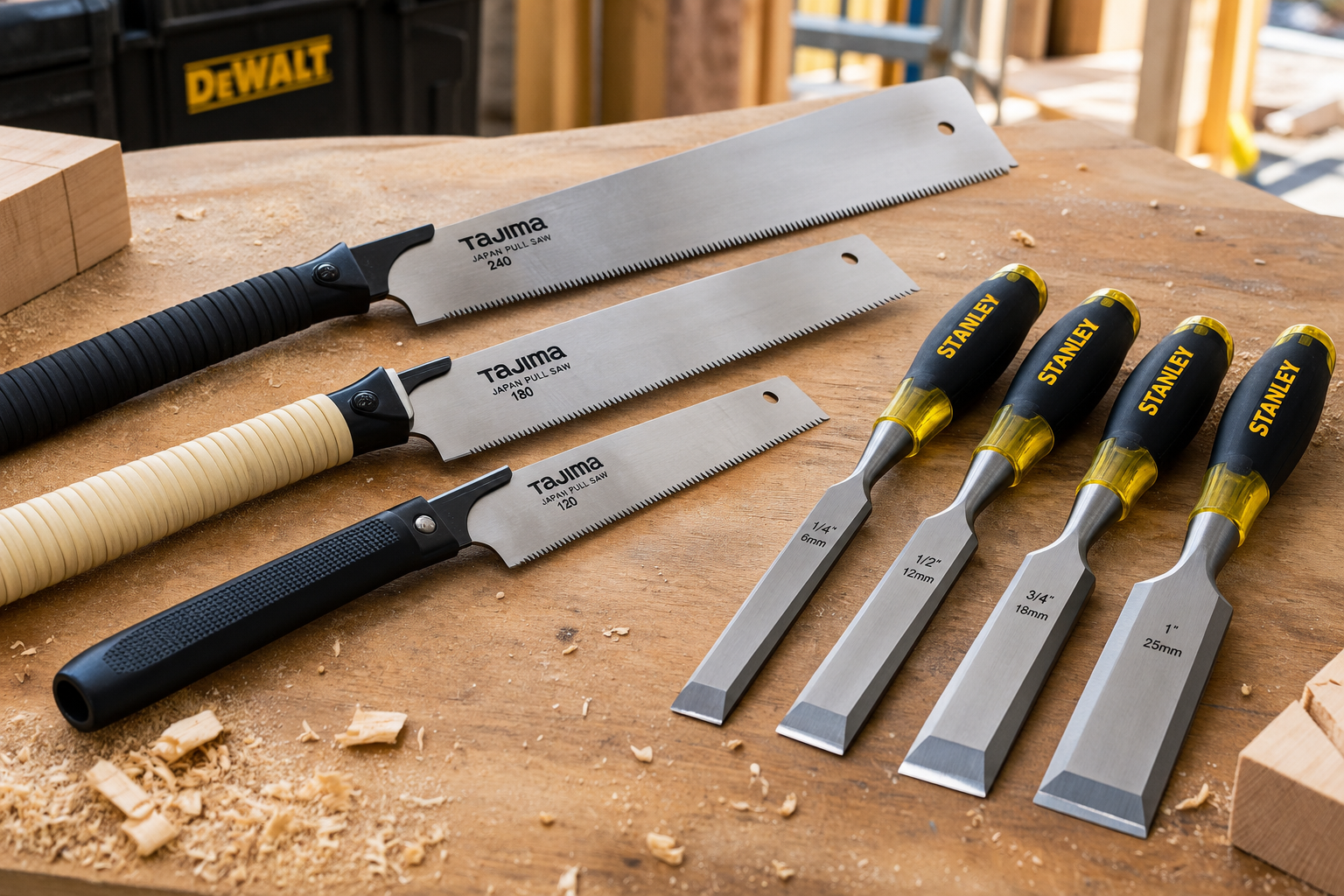
Knowing the right hand tool name matters when precision work or tight spaces make power tools the wrong choice. Many professional tradespeople still keep full hand tool kits because fine joinery, confined work, and delicate finishing need the direct feedback only manual tools deliver. Use this guide to identify common hand tools and choose the right type for your work.
At Slim’s Power Tools we stock the professional-grade hand tools Hawaii contractors, finish carpenters, and serious DIYers rely on every day. Our Honolulu and Kahului locations carry professional hand tools and Japanese-designed tools built for the island’s humidity, salt air, and dense materials.
What Are Hand Tools? Definition and Core Categories
Hand tools are manually powered implements that need no electricity or fuel. They provide direct control without the motor-driven torque of a power tool.
Professional hand tools fall into six functional groups:
| Category | Examples | Primary Use |
|---|---|---|
| Cutting | Saws, chisels, knives | Material removal and shaping |
| Striking | Hammers, mallets | Driving fasteners and setting parts |
| Fastening | Screwdrivers, wrenches | Securing fasteners |
| Measuring & Marking | Tape measures, squares, levels | Layout and accuracy |
| Gripping & Holding | Pliers, clamps, vises | Securing workpieces |
| Shaping | Planes, files, scrapers | Surface refinement |
Hand tools outperform power tools in three clear situations: when you need immediate tactile feedback (a hand plane taking a 0.001-inch shaving), when the space is too tight for a power tool body, and when the material is too delicate for high-speed power.
Hawaii’s humidity and salt air make corrosion protection especially important for metal hand tools. Our Japanese hand tools include specialized cutting tools designed for controlled, precise work.
Essential Cutting Tools: Saws, Knives, and Chisels
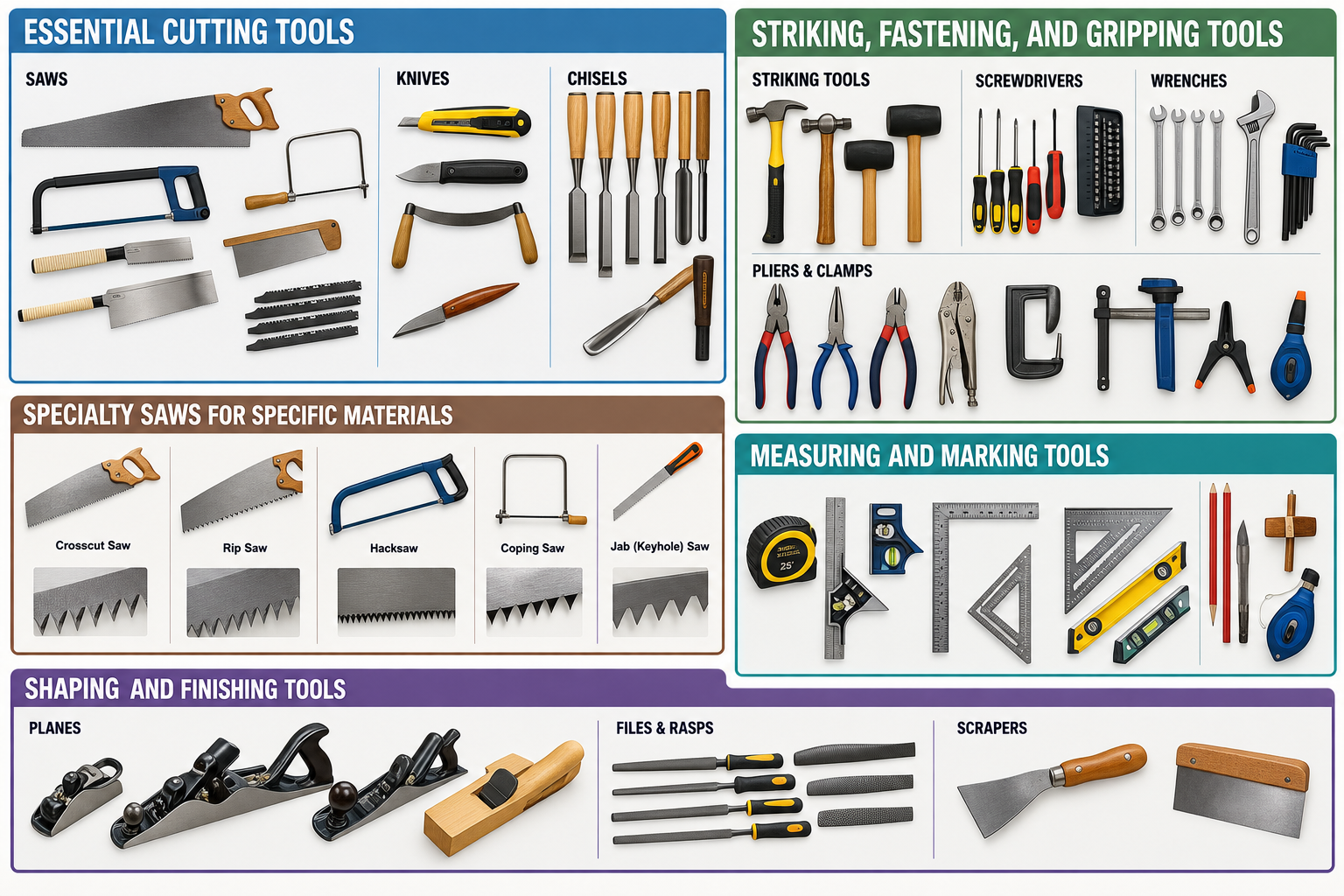
Cutting tools remove material by shearing. The three main types are saws, chisels, and utility knives. Each has different blade geometry and edge angles.
Saws differ by tooth pattern and stroke direction. Panel (hand) saws handle general crosscutting and ripping. Hacksaws cut metal and plastic with fine-toothed replaceable blades under tension. Coping saws follow curves. Dovetail saws give clean joinery cuts with a reinforced back that stops flex. Japanese pull saws (nokogiri) cut on the pull stroke. Hand tightening should follow the fastener, material, and application requirements. Use a torque wrench when a specified torque value is required.
At Slim’s we carry Tajima and Takagi/Shark pull saws in multipurpose, rapid-cut, detail, and double-edged styles, plus replacement blades. These are popular with finish carpenters working Hawaiian hardwoods.
Chisels pare, mortise, and shape by direct edge pressure. Bench chisels (¼" to 2") handle general work. Mortise chisels have thicker blades for chopping hinge seats and lock recesses. Gouges have curved profiles for concave work. Carbon steel sharpens easily but needs extra rust protection in Hawaii’s humidity. Alloyed tool steels resist corrosion better.
Utility knives with replaceable blades cut drywall, packaging, and laminate. Drawknives remove stock quickly in green woodworking. Scoring knives mark veneer cleanly where saw teeth would tear.
Specialty saws for specific materials
Tooth geometry decides efficiency. Crosscut saws use knife-edged teeth to sever fibers across the grain. Rip saws use chisel-edged teeth to remove material along the grain. Using the wrong saw doubles the effort and leaves a rough cut. Hacksaws need proper blade tension so they track straight. Coping and jab (keyhole) saws reach curves and interior cutouts.
Striking, Fastening, and Gripping Tools
Striking tools transfer force without damaging surfaces or fasteners. Claw hammers (16–20 oz) drive and pull nails. Use 16 oz models for finish work and 20 oz models for framing. Ball-peen hammers shape metal and set rivets. Mallets (wood, rubber, or dead-blow) protect surfaces and eliminate bounce. We stock Stiletto titanium hammers that reduce weight and arm fatigue on long days, along with Wilton and Crescent options.
Screwdrivers must match the drive system. Phillips, flathead, Torx, and hex each require the correct tip size. Larger handle diameters reduce hand fatigue during repetitive work. We carry Crescent, Stanley, and multi-bit sets.
Wrenches apply rotational force. Combination wrenches give open-end and box-end options. Adjustable wrenches fit multiple sizes. Allen keys reach recessed fasteners. Hand-tightening usually reaches 15–20 ft-lbs, enough for most non-structural work.
Pliers and clamps grip, bend, and hold. Combination pliers, needle-nose, diagonal cutters, and locking pliers (Vise-Grip) cover most needs. C-clamps, bar clamps, and spring clamps secure assemblies. Channellock and Vise-Grip tools are standard in our inventory.
Measuring and Marking Tools: Precision Fundamentals
Accuracy starts with reliable measuring tools. Tape measures come in accuracy classes: Class I (±1/32" over 6 ft) for finish work, Class II (±1/16") for general construction. A 25-foot tape is the common jobsite length.
Squares establish right angles. Combination squares handle 45° and 90° plus depth gauging. Framing squares lay out rafters. Speed squares mark angles fast. Check squares periodically against a known reference, especially if accuracy is critical.
Spirit levels set horizontal and vertical planes. Four-foot levels cover most work; torpedo levels fit tight spots. Carpenter’s pencils, marking knives, marking gauges, and chalk lines create the reference lines that keep cuts accurate. Marking knives produce finer lines than pencils when the kerf must split the line exactly.
Shaping and Finishing Tools
Planes smooth surfaces and reduce thickness with thin shavings. Block planes (6–7") handle end grain and chamfers. Jack planes remove material quickly. Smoothing planes produce final surfaces. A properly tuned Japanese plane can produce extremely fine shavings and a smooth surface on suitable woods, which may reduce the need for additional sanding.
Files and rasps shape with abrasive teeth. Bastard cut removes material fast; smooth cut finishes finer. Flat, round, and half-round profiles match the work. Scrapers (card or cabinet) remove gossamer shavings and clear tear-out without loading pores with dust.
Safety, Maintenance, and Building Your Kit
Dull tools can increase the force required and may increase the risk of slipping. Keep cutting tools sharp and in good condition. Use the bevel angle recommended for the specific chisel or plane iron and its intended application. Saw setting is best left to a professional shop for valuable blades. We offer sharpening service for eligible saw blades and cutting accessories at both locations.
Hawaii’s humidity demands active rust prevention. Store tools with desiccant packs. Apply an appropriate rust preventative as needed based on storage conditions and manufacturer guidance. Choose storage that allows tools to remain dry and provides adequate ventilation for Hawaii’s humid conditions.
Inspect handles for cracks, edges for chips, and measuring tools for accuracy before each use. Always cut away from your body and secure the workpiece.
A solid starter kit of about 20 tools covers most professional needs: 25-foot tape, combination square, spirit level, utility knife, claw hammer, adjustable wrench, screwdriver set, combination and needle-nose pliers, diagonal cutters, handsaw, chisel set (¼", ½", ¾", 1"), block plane, chalk line, marking knife, and a few C-clamps, all in a durable toolbox or bag. Invest in quality for the tools you use daily and for measuring tools. Economy tools work for occasional specialty tasks.
Why Slim’s Power Tools Is Different from Big-Box or Online-Only Retailers
Big-box stores stock shallow selections aimed at homeowners. Online retailers cannot let you feel the balance of a hammer or the edge of a chisel before you buy, and shipping delays stop jobs. We maintain deep local inventory on Oahu and Maui so you can walk in and leave with the tool the same day. Our staff has decades of combined experience with the exact conditions Hawaii jobsites face, including salt air, humidity, and dense volcanic aggregate. We repair major brands, offer sharpening, and can special-order items not currently on the shelf. Family-owned since 1972, we focus on the professional tools that keep crews working, not the mid-tier homeowner brands.
Hand Tools and Services We Offer Related to This Guide
- Tajima and Takagi/Shark Japanese pull saws, detail saws, and replacement blades
- Professional utility knives and replacement blades (Tajima and Stanley)
- Stiletto titanium hammers and Western framing/finish hammers
- Crescent, GearWrench, and Channellock wrenches, pliers, and fastening tools
- Stanley and Hultafors chisels, marking tools, and layout equipment
- Irwin and Wilton clamps and holding tools
- Tool bags, belts, and storage from CLC and others
- Sharpening service for eligible saw blades and cutting accessories
- Special-order support for hard-to-find sizes and models
- Local stock at Honolulu (1626 Republican Street) and Kahului (142 Kalepa Place)
Select Tools That Match Your Actual Work
Choose hand tools based on the material removal rate and finish quality your work requires, the accuracy tolerances of your projects, and how often you will use each tool. Start with the core kit and prioritize quality for daily-use and measuring tools. Add specialty tools as your projects require them.
Frequently Asked Questions
What hand tools do most Hawaii contractors need first?
A reliable 25-foot tape measure, combination square, claw hammer, utility knife, adjustable wrench, screwdriver set, pliers, handsaw, and basic chisels cover the majority of daily tasks. Add clamps and a block plane for finish work.
Why choose Japanese pull saws for carpentry in Hawaii?
They cut on the pull stroke with thinner blades, producing narrower kerfs and cleaner results on dense tropical hardwoods. We stock Tajima and Takagi/Shark models with replacement blades ready for pickup.
How should I protect hand tools from Hawaii humidity and salt air?
Wipe them after use, apply light oil or rust preventative regularly, and store them with desiccant packs in ventilated bags or boxes. Avoid leather rolls that trap moisture.
Does Slim’s sharpen hand saws and chisels?
We offer sharpening for eligible saw blades and cutting accessories. Call the Honolulu or Kahului store to confirm whether your specific item qualifies and for current turnaround.
Can I buy individual tools or only sets?
Both. We stock individual tools in common sizes as well as organized sets from Crescent, GearWrench, Stanley, and others. Tell us what you already own and we will help fill the gaps.
Do you carry tools for electrical or plumbing work?
Yes. Pliers, cutters, screwdrivers, nut drivers, and specialized wrenches are available. Confirm any required insulation ratings before using tools on energized equipment.
Ready to Build or Upgrade Your Hand Tool Kit?
Visit Slim’s Power Tools in Honolulu or Kahului, handle the tools yourself, and get advice from staff who understand Hawaii jobsite conditions. Join the e-Power Club for member alerts on promos and new stock. We have served local professionals since 1972 and keep the tools that keep your work moving.
Shop our full selection of professional hand tools and Japanese hand tools today, or call either store to confirm the exact size or model you need.
