
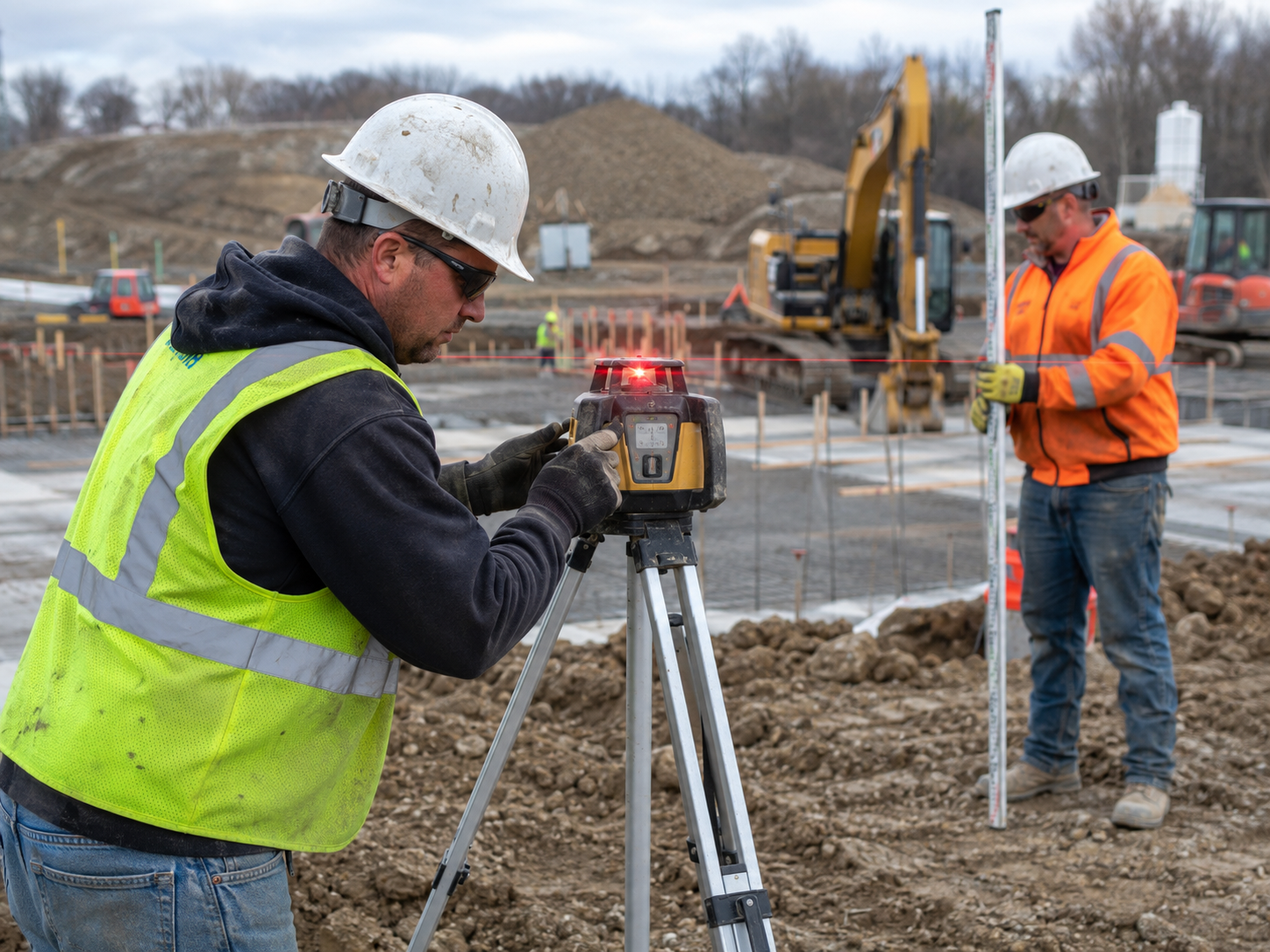
Layout errors destroy profit margins immediately. Pouring a commercial concrete foundation out of square requires hours of costly chipping and repouring. Modern construction schedules move too fast to rely on traditional string lines and water levels. Upgrading your layout equipment eliminates human error and drastically speeds up the initial phases of any commercial or residential build.
Slim’s Power Tools provides Hawaii contractors with precision measurement equipment designed specifically for rugged job sites. We know exactly what it takes to shoot accurate grades in the glaring tropical sun. This guide breaks down the essential layout tools required to keep your crews operating efficiently and accurately.
Rotary Laser Levels for Contractors: The Site Foundation
Rotary lasers serve as the foundation of heavy commercial layout. These devices project a 360-degree beam across massive job sites. A rotary laser level for contractors acts as a centralized reference point for entire earthmoving and concrete crews.
When shooting grades for a new driveway or establishing foundation elevations, a rotary laser paired with an electronic laser detector provides millimeter accuracy over hundreds of feet. The spinning internal diode creates a solid, continuous plane of light. Operating at high speeds up to 1200 RPM, the laser communicates with a receiver mounted on a grade rod. The receiver indicates high and low spots instantly with an audible beep. This allows a single operator to check grades across an entire acre without needing a second person to hold a tape measure.
Advanced Rotary Features: Dual-Slope and Electronic Leveling
Basic rotary lasers shoot a perfectly flat horizontal plane. Advanced models feature dual-slope capabilities. This allows civil contractors to dial in exact compound grades for parking lot drainage or ADA-compliant walkways. The laser adjusts the X and Y axes independently to project a precise angled plane over a massive distance.
Internal leveling mechanisms determine the absolute accuracy of the tool. Pendulum-based lasers use gravity to find level. Electronic self-leveling models utilize internal servomotors and precision sensors. The electronic servomotors provide higher accuracy and remain stable even if heavy machinery operating nearby vibrates the ground. If a bulldozer bumps the tripod, the electronic sensor immediately stops the laser rotation to prevent the crew from working off a compromised reference line.
Working with Laser Receivers and Grade Rods
A rotary laser is essentially useless outdoors without an electronic receiver. The receiver detects the laser beam even when the human eye cannot see it in direct sunlight. You mount the receiver to an aluminum or fiberglass grade rod.
Fiberglass grade rods provide electrical insulation. This makes them mandatory when shooting grades near overhead power lines or open trenches with live utilities. Aluminum rods are lighter but conduct electricity.
The receiver features an LCD screen displaying arrows pointing up or down. As you move the receiver up and down the grade rod, the arrows guide you toward the exact center of the laser beam. High-end receivers feature direct millimeter readouts. This tells the operator exactly how much dirt needs to be removed or added without requiring any manual math.
Construction Laser Levels for Interior Build-Outs
Once the exterior shell goes up, interior crews take over the layout process. Construction laser levels designed for interior work utilize static line projections rather than spinning diodes.
Cross-Line and Multi-Plane Lasers
Cross-line lasers project intersecting vertical and horizontal lines directly onto a wall. These tools are mandatory for framing metal studs, installing drop ceilings, and laying out complex commercial tile grids. A contractor can establish a perfectly plumb wall layout across an entire room in seconds.
Multi-line or 3-plane lasers project three independent 360-degree lines. This creates a complete grid of intersecting reference points across the floor, walls, and ceiling. Cabinet installers rely heavily on 3-plane lasers to hang upper cabinets perfectly level across long kitchen walls without pulling a tape measure multiple times. The constant visual reference prevents compounding errors as you move down the wall.
Plumb Spot Lasers
Plumb lasers project concentrated dots straight up and straight down. Electricians use them to transfer lighting layouts from the floor directly to high vaulted ceilings. Plumbers use plumb spots to align pipe penetrations through multiple floors of a commercial building. The concentrated dot provides exact alignment without dropping a traditional heavy brass plumb bob.
The Green Beam Advantage in Hawaii
Visibility remains the biggest challenge when operating lasers outdoors. Red laser beams become virtually invisible under the bright Hawaiian sun. Green laser diodes project light at a wavelength that appears up to four times brighter to the human eye.
Choosing a green beam laser increases your working visual range without relying constantly on an electronic receiver. You can see a green line clearly on a concrete wall from fifty feet away in broad daylight. Green diodes consume more battery power and cost slightly more to manufacture. The massive increase in job site visibility justifies the initial investment for exterior contractors and framers working in open conditions.
Digital Levels for Precision Fabrication
Lasers handle long distances across the job site. Digital levels dominate localized, high-precision tasks. A standard spirit bubble vial leaves room for visual interpretation. Digital levels eliminate this guesswork entirely by providing an exact numerical readout of the pitch or slope on an LCD screen.

Digital levels provide exact slope readouts for strict building code compliance.. Source: Visivasnc
Building inspectors strictly enforce slope requirements for commercial plumbing runs and wheelchair ramps. A digital level provides instant confirmation that a concrete ramp drops exactly one-twelfth of an inch per foot. The digital readout proves compliance instantly.
Finish carpenters use digital levels to calibrate miter saw blades to perfect 90-degree or 45-degree angles before cutting expensive tropical hardwoods. Heavy machinery operators use compact magnetic digital levels to verify the angle of bulldozer blades and excavator buckets. The backlit digital displays remain highly visible in dark workspaces and often feature audible tones that beep when you hit exactly level or plumb.
Layout Tool Selection Matrix
The primary capabilities of each laser type help you equip your specific trade with the correct measurement tool.
| Tool Type | Primary Use Case | Maximum Effective Range | Key Feature |
|---|---|---|---|
| Rotary Laser | Site grading, foundations, concrete pours | 1,000+ feet (with receiver) | 360-degree spinning projection |
| 3-Plane Laser | Cabinetry, drop ceilings, squaring rooms | 100 – 150 feet | Complete 3D room grid |
| Cross-Line Laser | Tile layout, metal stud framing | 50 – 100 feet | Intersecting horizontal/vertical lines |
| Plumb Spot Laser | Transferring layout floor-to-ceiling | 100 feet | Concentrated dot visibility |
| Digital Level | ADA ramps, pipe pitch, blade calibration | Localized (Tool length) | Exact digital slope readout |
Protecting Precision Tools on Island Job Sites
Layout tools house highly sensitive optical components and delicate internal sensors. Riding in the back of a contractor truck over rough terrain damages these mechanisms over time. You must select equipment rated specifically for the physical abuse of an active job site.
Look closely at the Ingress Protection (IP) ratings before purchasing a laser. The IP rating dictates how well the tool housing seals out environmental hazards.
- IP54 Rating: Provides basic protection against blowing dust and splashing water. Suitable for interior framing and finishing.
- IP65 Rating: The laser housing completely blocks fine volcanic dust and withstands low-pressure water jets from heavy tropical rain. Mandatory for heavy civil and concrete contractors.
Store all lasers in their original hard-sided, foam-lined cases. You should perform a simple field calibration check on your rotary laser every week. Place the laser exactly one hundred feet from a solid wall. Mark the beam height. Rotate the unit 180 degrees and mark the beam height again. If the two marks differ by more than a sixteenth of an inch, the unit requires professional factory calibration.
Equip Your Crew with Accurate Layout Tools
Investing in modern layout tools directly protects your profit margins. A high-quality laser level ensures your foundations sit square, your walls stand plumb, and your trim aligns perfectly. The initial cost of the equipment pays for itself rapidly by eliminating teardowns and material waste.
Visit Slim’s Power Tools at our Honolulu location or our Maui location to view our complete inventory of layout equipment. We stock heavy-duty lasers and digital measuring tools from the most trusted brands in commercial construction. Our knowledgeable staff can demonstrate the visibility differences between red and green beams in person. Check out our full selection of Electronics, Laser Devices, and Levels online and outfit your crew with the exact tools required to build with absolute precision.
