
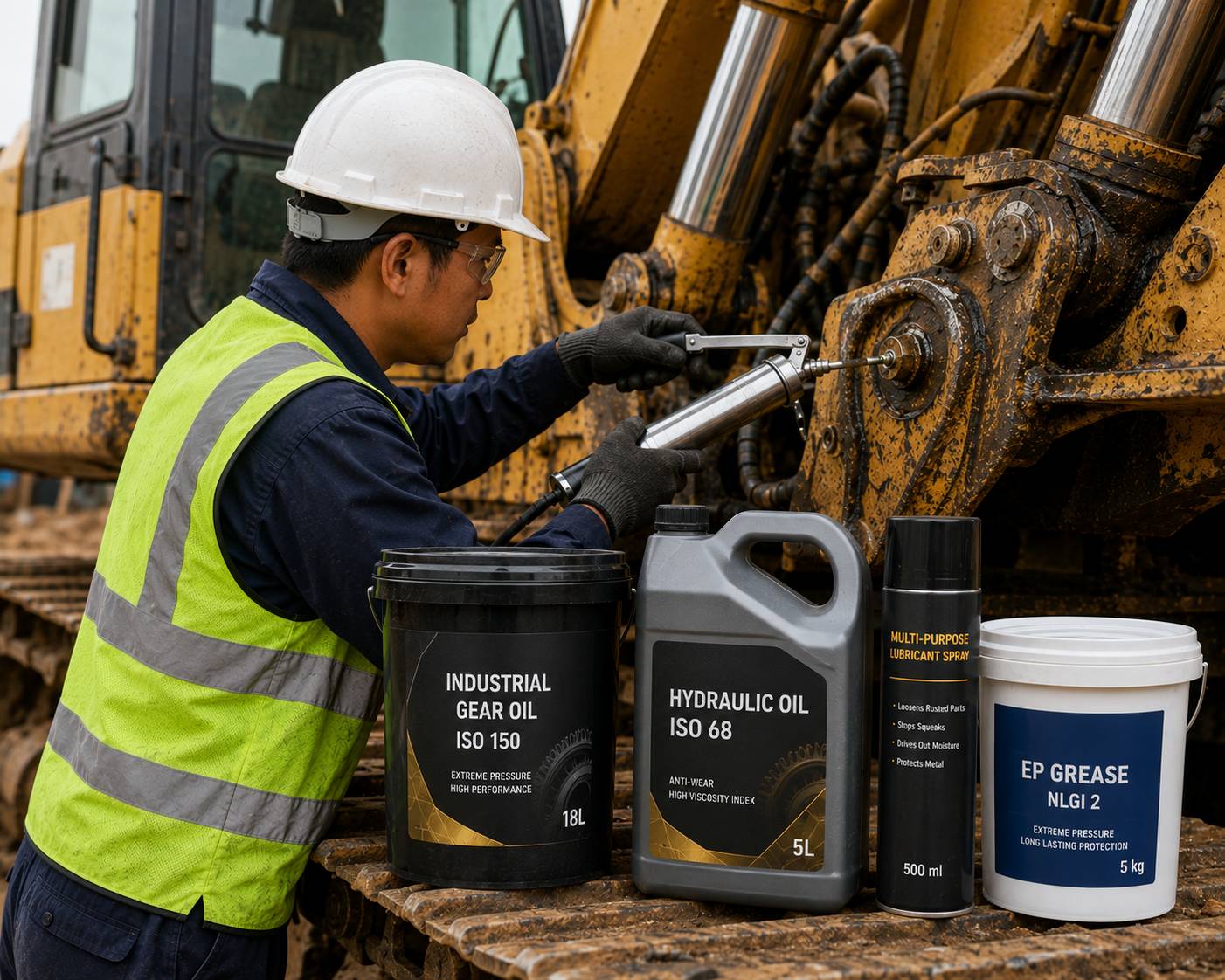
Heavy machinery on Hawaiian jobsites faces a unique combination of challenges that most mainland operations never experience. Salt-laden air rolls in from the ocean every day. High humidity saturates every surface. Fine volcanic dust and dense aggregate grind into moving parts. Intense UV and heat accelerate oxidation. Under these conditions, ordinary lubricants and chemicals simply do not last.
When lubrication fails, friction spikes, temperatures climb, seals harden or crack, and expensive components begin to wear at an accelerated rate. What starts as a minor grease point issue can quickly turn into seized pins, scored hydraulic cylinders, failed final drives, or complete equipment downtime. For contractors, that downtime is measured not just in repair costs but in lost production days, delayed schedules, and frustrated clients.
Industrial-grade lubricants and specialty chemicals are specifically engineered to handle extreme pressure, water washout, contamination, and thermal stress. Using the right products is one of the highest-return maintenance decisions a contractor or serious equipment owner can make in Hawaii. This is not about following a generic checklist—it is about protecting capital equipment that has to perform day after day in one of the most corrosive environments in the United States.
Consumer or light-duty products are formulated for milder conditions and shorter service intervals. They lack the additive packages, base oil stability, and film strength required when equipment operates in constant humidity and salt air. Industrial formulations, by contrast, are built for continuous heavy loads, high temperatures, and aggressive contamination.
In practical terms, the difference shows up in several critical areas:
The result is measurable: fewer unplanned repairs, longer component life, more consistent performance, and lower total cost of ownership. On a fleet of excavators, loaders, or generators, those savings compound quickly.
Many operators discover the hard way that “good enough” grease or hydraulic fluid costs far more in the long run. A single failed boom pin or a scored hydraulic cylinder can easily exceed the annual cost of using proper industrial products across an entire fleet.
Understanding the main categories helps you match the right product to the application. Below is a practical overview tailored to the equipment commonly seen on Hawaiian construction and industrial sites.
| Product Type | Primary Applications | Key Performance Needs in Hawaii |
|---|---|---|
| Extreme-pressure (EP) greases | Pins, bushings, bearings, track rollers, linkages | High load capacity, water washout resistance, corrosion protection |
| Hydraulic fluids (AW / ISO) | Cylinders, pumps, motors, valves | Viscosity stability in heat, anti-wear, demulsibility |
| Gear and transmission oils | Final drives, differentials, gearboxes | Extreme pressure additives, thermal stability, contamination resistance |
| Corrosion inhibitors & coatings | Exposed metal, electrical connections, undercarriages | Long-term barrier against salt air and humidity |
| Penetrating oils & dry-film lubricants | Seized fasteners, sliding surfaces, cables | Fast penetration without residue that attracts dust |
| Thread lockers & anaerobic sealants | Critical bolted joints, hydraulic fittings | Vibration resistance and sealing under harsh conditions |
| Specialty cutting fluids & cleaners | Metalworking, maintenance, parts cleaning | Performance in high humidity without promoting rust |
Selecting the correct NLGI grade for grease, the proper ISO viscosity for hydraulic fluid, and the right base oil (mineral, synthetic, or semi-synthetic) matters. Using a product outside its designed range can cause just as many problems as using a low-quality one. Manufacturer specifications are the starting point; local operating conditions often require upgrading to a more robust formulation.
When industrial-grade lubricants and chemicals are applied correctly and consistently, they deliver benefits far beyond simple friction reduction.
First, they minimize metal-to-metal contact. Even under heavy loads and shock, a strong lubricating film prevents the microscopic welding and tearing that leads to wear particles and eventual failure.
Second, they manage heat. Friction generates heat; heat accelerates chemical breakdown and softens seals. High-quality lubricants carry heat away more effectively and resist thinning at elevated temperatures.
Third, they act as a barrier against contaminants. Quality greases and oils help seal out moisture, salt, and abrasive dust. Many industrial products also contain detergents and dispersants that keep internal systems cleaner.
Fourth, they actively fight corrosion. Salt air is relentless. Corrosion inhibitors in modern industrial lubricants form protective films on metal surfaces, dramatically slowing the oxidation process that destroys pins, cylinders, and structural components.
Fifth, they improve operating efficiency. Lower internal friction means less energy is wasted as heat. Over time this translates into modest but real fuel or power savings, especially on machines that run long hours.
Finally, they extend service intervals. Because industrial products hold up longer under stress, re-lubrication and fluid change intervals can often be lengthened without increasing risk provided the equipment is inspected regularly. In Hawaii’s severe environment, many experienced operators still choose to service critical points more frequently than the manufacturer’s minimum recommendation.
The combination of these effects is powerful: equipment stays productive longer, repair costs drop, and the overall reliability of the fleet improves.
Even the best product fails if it is applied incorrectly or inconsistently. A few practical habits make a large difference:
In coastal or high-humidity locations, more frequent attention to exposed pins, undercarriage components, and electrical connections pays dividends. Salt deposits should be rinsed or neutralized when practical, and protective coatings reapplied as needed.
National chains and online suppliers stock popular brand names, but they rarely maintain deep inventories of the heavy-duty, Hawaii-appropriate formulations that professional operators actually need. Technical advice is often limited or generic. Delivery times for specialty items can stretch into days or weeks.
Slim’s Power Tools has operated as a family-owned business in Hawaii since 1972, with a second location on Maui since 1993. We understand the local environment because we live and work in it. Our inventory focuses on professional-grade tools, equipment, and supplies that contractors rely on every day. That includes a carefully selected range of industrial lubricants, greases, hydraulic fluids, corrosion inhibitors, penetrating oils, thread lockers, and related chemicals.
Staff are trained to help customers match products to real jobsite conditions rather than simply reading a label. When you need something today, local stock on both Oahu and Maui means you can get it without waiting for a mainland shipment. That combination of expertise, inventory depth, and genuine local knowledge is difficult to replicate through a big-box aisle or a website shopping cart.
These products support the full range of equipment common on local jobsites—from excavators and loaders to generators, compressors, and concrete machinery.
Check our productsAutomotive greases generally lack the extreme-pressure additives, water resistance, and corrosion protection needed for high-load pins, bushings, and tracks. In salt air and humidity they wash out or break down faster, leading to accelerated wear and unexpected failures.
Start with the manufacturer’s recommendation, then increase frequency based on operating conditions. Many local contractors grease high-wear points daily or every shift when working in wet, dusty, or coastal environments.
In severe service they usually are. Synthetics typically provide better thermal stability, longer life, superior film strength, and improved resistance to moisture and oxidation. The extended component life and reduced downtime often more than offset the initial cost difference.
Hawaii’s relatively stable temperatures make properly selected multi-grade or ISO-viscosity fluids practical for most of the year. Always follow the equipment manufacturer’s specifications and consider upgrading to a higher-performance fluid if the machine runs hot or works in especially humid conditions.
Slim’s Power Tools maintains professional-grade inventory at both locations and staff who understand local conditions. You can walk in, get what you need the same day, and receive practical recommendations based on real Hawaiian jobsites.
Yes. We carry corrosion inhibitors, protective coatings, and lubricants formulated to resist moisture and salt—essential protection for any equipment that works near the coast or sits in high humidity.
Protecting heavy machinery with industrial-grade lubricants and chemicals is one of the most cost-effective ways to keep equipment productive and profitable in Hawaii. The right products reduce friction, control heat, block corrosion, and extend component life under conditions that defeat ordinary oils and greases.
Visit Slim’s Power Tools in Honolulu at 1626 Republican Street or on Maui at 142 Kalepa Place in Kahului. Call (808) 841-0902 or (808) 242-7878 for current inventory and advice. Join the e-Power Club for exclusive promotions, early access to deals, and updates tailored to professional users.
Mahalo for trusting Hawaii’s family-owned tool specialists since 1972. Let’s keep your machines running strong in the conditions they face every day.
