
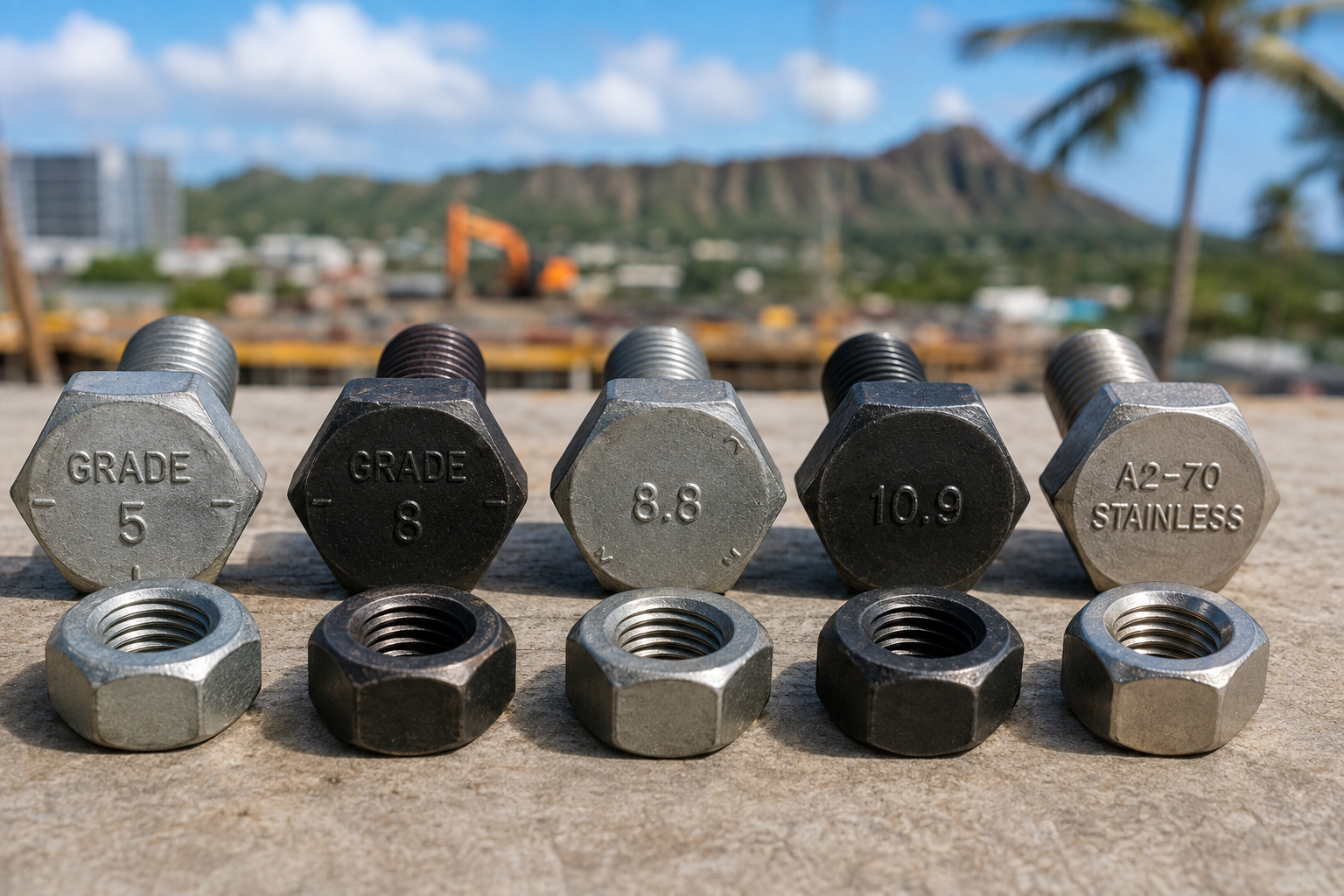
Choosing the wrong bolt can quietly undermine an entire connection. On commercial construction sites and serious projects across Hawaii, the difference between a reliable joint and a potential failure often comes down to selecting the correct fastener grade and material. A bolt that looks sturdy enough may lack the tensile strength required for the load, or it may corrode rapidly in salt air and lose capacity long before the structure reaches the end of its design life. Conversely, over-specifying the strongest available grade can waste money, make installation more difficult, and sometimes introduce brittleness that actually reduces performance under certain conditions.
Understanding fastener grades is not just about memorizing numbers. It is about matching mechanical properties, corrosion resistance, and code requirements to the real demands of the job. Hawaii’s unique combination of high humidity, coastal salt exposure, dense volcanic aggregate, and strict wind-zone structural rules makes this decision especially important. Whether you are securing structural steel, anchoring equipment, framing a commercial build, or completing a high-end residential project, knowing which bolt strength you actually need protects both safety and your bottom line.
Why Fastener Grades Matter
Bolt grades communicate the material strength and expected performance of the fastener under load. Higher grades typically deliver greater tensile and yield strength, but strength is only one part of the equation. Toughness, ductility, corrosion resistance, and compatibility with the joined materials all influence long-term reliability.
In practice, using an under-graded bolt risks stretching, shearing, or sudden failure. Using an over-graded bolt in the wrong application can lead to cracked concrete, damaged threads, or brittle fracture if the fastener is over-torqued. The goal is always to select the grade that safely carries the design load while remaining practical to install and durable in the environment.
Common SAE Bolt Grades (Inch Series)
Most contractors working with inch-series fasteners rely on the SAE grading system. These grades are identified by radial line markings on the bolt head and are widely available on Hawaiian jobsites.
| Grade | Head Marking | Approx. Tensile Strength | Typical Uses | Notes for Hawaii |
|---|---|---|---|---|
| Grade 2 | No marks or plain | 74,000 psi | Light-duty, non-critical | Rarely appropriate for structural work |
| Grade 5 | 3 radial lines | 120,000 psi | General construction, machinery, framing | Excellent everyday balance of strength |
| Grade 8 | 6 radial lines | 150,000 psi | High-stress, heavy equipment, critical | Strong but less forgiving if over-torqued |
| Grade 8.2 | 6 lines + additional | Similar to Grade 8 | Some structural applications | Always verify manufacturer data |
Grade 5 remains the most commonly specified fastener for general commercial and residential construction. It offers solid strength with good toughness. Grade 8 is reserved for applications where higher tensile capacity is clearly required.
Metric Bolt Grades
Metric fasteners use a numerical property class system that directly indicates strength. The first number relates to tensile strength and the second to the ratio of yield to tensile strength.
| Property Class | Head Marking | Approx. Tensile Strength | Common Applications |
|---|---|---|---|
| 4.6 / 4.8 | 4.6 or 4.8 | Lower strength | Light duty only |
| 8.8 | 8.8 | ~116,000 psi | General structural and machinery |
| 10.9 | 10.9 | ~150,000 psi | High-strength and critical connections |
| 12.9 | 12.9 | ~174,000 psi | Specialized high-stress applications |
Class 8.8 is roughly equivalent to SAE Grade 5, while 10.9 aligns closely with Grade 8. Always confirm the exact specifications when substituting between systems.
How to Identify Bolt Grades on the Jobsite
The most reliable method is to examine the head markings. SAE grades use radial lines. Metric grades display numbers such as 8.8 or 10.9. Stainless steel fasteners are typically marked with the alloy designation (A2-70, A4-80, etc.).
If markings are worn, painted over, or missing, do not assume strength. Treat unmarked bolts as the lowest common grade or replace them. Never rely on appearance, color, or “feel” alone. A shiny bolt is not automatically high-strength, and a dull or weathered bolt is not automatically low-strength.
Matching Bolt Strength to the Actual Job
Before selecting fasteners, work through a few practical questions:
- What combination of tension, shear, and cyclic loading will the connection see?
- Is the joint structural or non-structural?
- Will the fastener be exposed to weather, salt air, chemicals, or concrete dust?
- Do project specifications or local building codes dictate minimum strength or material?
- Is future disassembly required, or is this a permanent connection?
For many general construction tasks across Oahu and Maui, Grade 5 or metric 8.8 provides an excellent balance of strength, toughness, and cost. Higher-stress or engineer-specified connections may require Grade 8 or 10.9. In exterior or coastal applications, corrosion resistance frequently becomes the deciding factor. Type 316 stainless steel or properly coated carbon-steel fasteners often outperform bare high-strength bolts over the life of the structure.
Hawaii-Specific Considerations
Hawaii’s environment introduces challenges that pure strength ratings do not address. Salt air rapidly accelerates corrosion on unprotected carbon steel. High humidity and temperature swings affect coatings and lubricants. Dense volcanic aggregate is highly abrasive during drilling and installation. Strict wind-zone requirements place additional demands on structural connections.
Experienced local contractors therefore evaluate both mechanical properties and long-term durability. Many exterior and coastal applications prioritize Type 316 stainless steel, hot-dip galvanized fasteners, or specialized coatings even when a lower mechanical grade would theoretically carry the load. Properly rated structural anchors and epoxy systems for concrete are equally important. Selecting a fastener that meets both strength and environmental demands reduces call-backs and protects the integrity of the work.
Why Slim’s Power Tools Is Different
Big-box retailers typically stock limited fastener selections aimed at consumer and light-duty needs. Online suppliers may offer extensive catalogs but cannot provide same-day local availability or practical guidance tailored to Hawaiian conditions. Slim’s Power Tools has served Hawaii’s professional trades since 1972, maintaining a deep inventory of structural bolts, stainless fasteners, anchors, and related hardware at both the Honolulu and Kahului locations. Our team understands the interplay of strength requirements, corrosion challenges, and local code expectations, helping you choose the right fastener the first time and keep projects on schedule.
Products & Services at Slim’s Power Tools
- Structural bolts and nuts in common SAE and metric grades
- Type 316 stainless steel fasteners for coastal and exterior exposure
- Hot-dip galvanized and specially coated fasteners
- Concrete anchors, wedge anchors, and epoxy injection systems
- Bulk quantities for commercial and multi-unit projects
- Expert guidance on grade selection and application suitability
- Special orders for hard-to-find sizes, grades, or materials
- Convenient local pickup at our Honolulu and Maui stores
Frequently Asked Questions
1. What is the practical difference between Grade 5 and Grade 8 bolts?
Grade 5 bolts provide approximately 120,000 psi tensile strength and suit most general construction. Grade 8 bolts offer about 150,000 psi and are used where higher capacity is required. Grade 8 is stronger but can be less ductile and more sensitive to over-torquing.
2. How can I quickly identify a bolt’s grade on site?
Examine the head. SAE Grade 5 shows three radial lines; Grade 8 shows six. Metric bolts are marked with numbers such as 8.8 or 10.9. Unmarked fasteners should be treated as low-strength or replaced.
3. Are stainless steel bolts as strong as Grade 5 or Grade 8 carbon steel?
Common stainless grades such as A2-70 generally have lower tensile strength than Grade 5 or 8. Their superior corrosion resistance, however, often makes them the better long-term choice in Hawaii’s coastal environment. Higher-strength stainless options are available for specific needs.
4. Do Hawaii building codes require particular fastener grades?
Codes focus on structural performance, approved systems, and durability rather than a single universal grade. High-wind zones and coastal exposure frequently drive requirements for corrosion-resistant materials and engineered connections. Always follow project specifications and local inspection requirements.
5. Is it acceptable to mix different bolt grades in the same connection?
Mixing grades is generally discouraged. Different strength levels can create uneven load sharing and potential failure points. Use consistent grades and materials unless an engineer specifically directs otherwise.
6. Does Slim’s carry structural and stainless fasteners in the quantities contractors need?
Yes. Slim stocks professional volumes of structural bolts, stainless fasteners, anchors, and related hardware at both locations. Call ahead with your list so we can confirm availability or arrange a special order.
Get the Right Fasteners for Your Hawaii Job Site
Stop guessing on fastener grades and get the combination of strength and corrosion resistance your project actually requires. Visit Slim’s Power Tools in Honolulu at 1626 Republican Street or in Kahului, Maui at 142 Kalepa Place. Call (808) 841-0902 (Oahu) or (808) 242-7878 (Maui) for expert assistance, or join our e-Power Club for exclusive deals and early access to professional supplies. When it comes to the right fasteners for Hawaii jobsites, there’s Slim’s—and there’s none.
