
Finish carpentry demands exact tolerances. A fraction of a millimeter determines whether a dovetail joint holds or fails. Woodworkers and professional contractors in Hawaii face the added challenge of manipulating dense tropical hardwoods. Local materials like Koa and Monkeypod feature interlocking grain patterns that tear out easily under inferior blades. Power tools handle the bulk material removal efficiently. Final fitting requires a completely different approach. Japanese hand tools offer a level of precision that heavy machinery cannot replicate.
Slim's Power Tools provides professional-grade equipment for these exact scenarios. Our inventory supports tradespeople who refuse to compromise on their finish quality. Understanding the engineering behind Japanese tools helps you make informed decisions for your shop.
The Philosophy of Japanese Tool Making
The construction of Japanese hand tools relies on centuries of metallurgical refinement. Master blacksmiths developed these exact forging techniques originally for sword making. They later adapted these processes for woodworking hand tools to create cutting edges of exceptional hardness.
Western hand tools typically utilize a single piece of homogenous steel. This makes mass manufacturing cheaper. It forces a direct compromise between hardness and durability. If the steel is too hard, the tool shatters under heavy impact. If the steel is too soft, the edge dulls immediately upon contacting dense wood.
Japanese tool makers solve this physics problem through lamination. They forge a thin layer of high-carbon steel directly to a thicker body of soft iron. The high-carbon steel undergoes a rapid water-quenching process. This quenching locks the molecular structure to take a razor-sharp edge. The soft iron backing remains untempered. It absorbs the massive shock of a hammer strike without transferring that stress to the brittle cutting edge. This forge-welding technique defines professional Japan hand tools.
The Mechanics of the Nokogiri (Pull Saw)
The most recognizable Japanese hand tool is the pull saw, known as the Nokogiri. The fundamental physics of the cut separate it entirely from a Western hand saw.
Western saws cut exclusively on the push stroke. Pushing a piece of metal through dense wood requires a thick steel plate to prevent the blade from buckling under the compressive pressure. This thick plate removes a wide swath of material. This removed material is called the kerf. Pushing a thick blade through a wide kerf demands significant physical exertion from the carpenter.
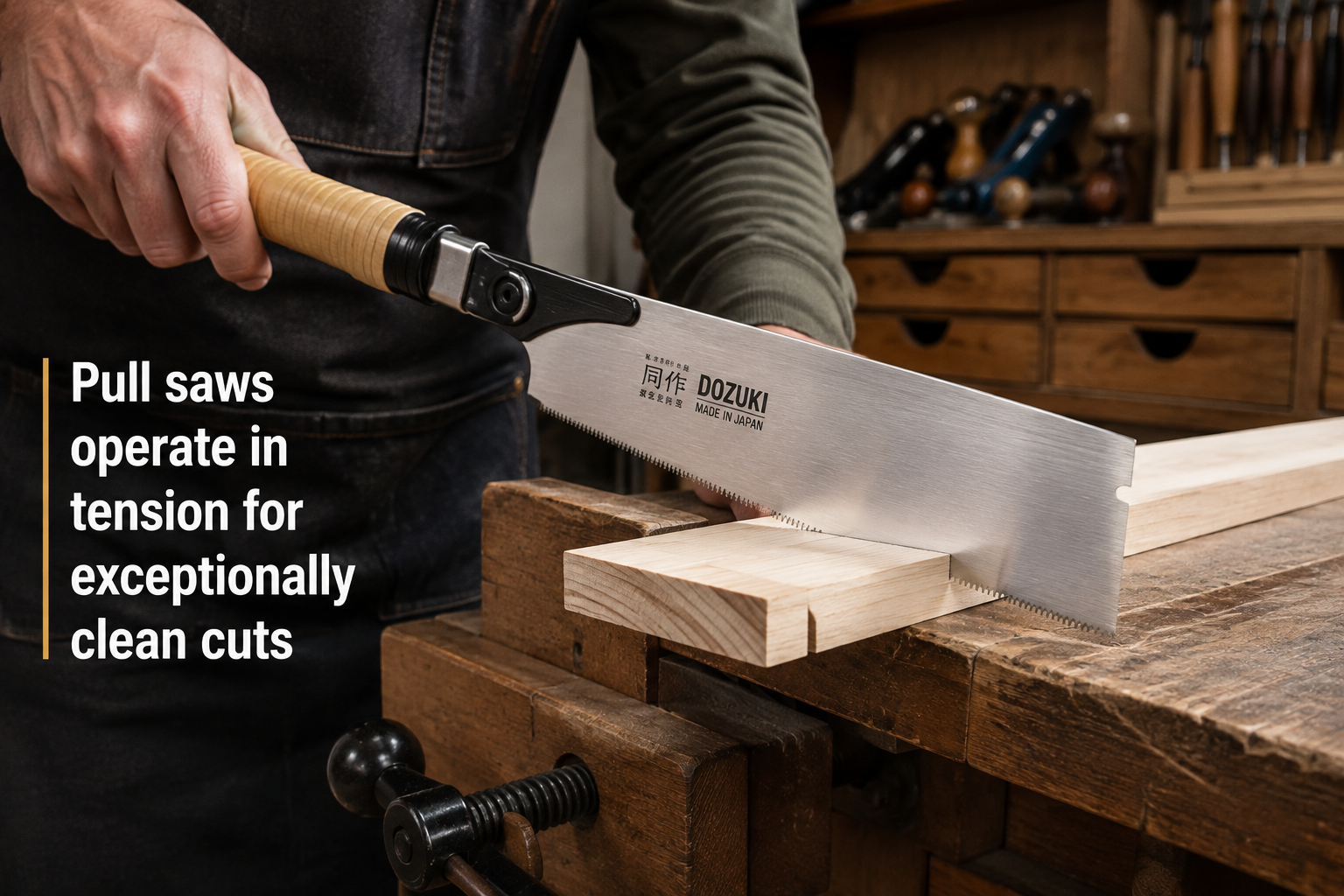
Japanese pull saws operate entirely in tension. Pulling the blade through the wood keeps the steel perfectly straight automatically. This tension allows the manufacturer to use incredibly thin steel. A thin blade creates a microscopic kerf. The narrow kerf removes far less wood fiber per stroke. Less material removal translates directly to less physical effort required over an eight-hour shift. The teeth themselves feature three distinct cutting bevels. Instead of tearing the wood fibers like a Western saw, the Nokogiri teeth slice the fibers cleanly. The resulting cut is surgically clean and requires minimal sanding.
Types of Japanese Pull Saws
Professional carpenters select specific saws based on the exact direction of the wood grain. Utilizing the wrong tooth profile results in slow cutting and ragged edges. The long handles feature a tight rattan wrap. This extended handle accommodates a two-handed grip for maximum stability and control.
Ryoba This is the most versatile Japanese pull saw available. The blade features cutting teeth on both edges. One side features large, progressive teeth designed for ripping directly down the length of the grain. The opposite side features finer teeth designed for crosscutting across the grain. A single Ryoba replaces two dedicated Western hand saws in your toolbox.
Dozuki This saw is built exclusively for precision joinery. A rigid steel spine runs along the entire top edge of the blade. This spine prevents the ultra-thin steel from flexing during delicate layout cuts. Woodworkers use the Dozuki for cutting dovetails and tenons where accuracy is paramount. The rigid spine limits the total depth of the cut.
Kataba This saw lacks the rigid spine of the Dozuki. It features teeth on only one side. The absence of a spine allows for deep cuts entirely through thick timbers. Carpenters use the Kataba for flush-cutting dowels and sizing large sheet goods.
Comparing Tool Mechanics
Reviewing the physical differences helps illustrate why professional carpenters transition to Japanese tools for finish work.
| Feature | Japanese Pull Saw (Nokogiri) | Western Push Saw |
|---|---|---|
| Cutting Action | Pull stroke (Tension) | Push stroke (Compression) |
| Blade Thickness | Ultra-thin | Thick and rigid |
| Kerf Width | Narrow | Wide |
| Physical Effort | Low | High |
| Finish Quality | Glass-smooth | Rougher edges |
Nomi: The Precision Laminated Chisel
Fine woodworking requires chisels that hold a sharp edge through hours of heavy use. Japanese chisels (Nomi) excel at edge retention due directly to their laminated construction. The cutting edge consists of specialized White Paper Steel or Blue Paper Steel. These are pure high-carbon alloys forged specifically for extreme sharpness. A softer wrought iron body supports this brittle cutting edge.
A heavy steel hoop sits at the top of the wooden handle. This hoop prevents the red oak or white oak wood from splitting when struck heavily. Western chisels are pushed by hand or tapped gently with a wooden mallet. Japanese chisels are engineered to be struck with a heavy steel hammer (Genno). The soft iron body absorbs the strike and transfers the force directly to the cutting edge.
The back of a Japanese chisel features a hollow depression called the ura. This hollow reduces the flat surface area of the steel. A smaller surface area means you spend significantly less time flattening the back of the chisel on your sharpening stones. The flat perimeter of the ura maintains perfect registration against the wooden workpiece.
Kanna: The Wooden Block Plane
The Japanese block plane (Kanna) consists of a simple wooden block (the Dai) and a massive laminated steel blade. Unlike complex Western cast-iron planes featuring multiple brass adjustment screws, the Kanna relies entirely on the physical skill of the user. The carpenter adjusts the blade projection using light taps from a specialized hammer.
Like the saws, the Kanna cuts exclusively on the pull stroke. Pulling the plane engages the woodworker's core muscles for maximum control and stability. The thick, laminated blade prevents micro-vibrations (chatter) during the cut. The sole of the wooden body is not perfectly flat. The carpenter scrapes the sole to create specific contact points. This reduces friction against the workpiece. A properly tuned Kanna produces a continuous wood shaving thin enough to read a newspaper through. The planed wood surface shines like glass and requires absolutely no sanding before applying a clear finish.
Maintenance and Sharpening in the Hawaii Climate
The exact metallurgical properties that make Japanese hand tools exceptionally sharp also make them highly susceptible to rust. High-carbon steel lacks the chromium content found in standard stainless steel. The tropical humidity and pervasive salt air of Hawaii will rust an unprotected blade overnight. Contractors and woodworkers on Oahu and Maui must implement strict maintenance routines to protect their financial investment.
You must wipe down every steel blade at the end of the shift to remove acidic wood resins. Apply a light coat of camellia oil to the steel before storing the tool. Camellia oil is a traditional Japanese rust preventative that will not stain your finished woodwork. Store your hand tools in a dry toolbox equipped with silica gel desiccants to manage the ambient moisture.
You cannot sharpen laminated Japanese tools on a high-speed dry bench grinder. The friction generates extreme heat. This heat instantly ruins the temper of the thin carbon steel edge. You must sharpen these tools exclusively on Japanese water stones. Water stones use a slurry of abrasive grit and water to polish the steel slowly. This process keeps the metal perfectly cool and refines the edge to a mirror polish.
Outfitting Your Shop with Premium Gear
Investing in Japanese hand tools elevates the exact quality of your finished carpentry. These tools demand respect and proper daily maintenance. The reward is unmatched precision and a deeper physical connection to your craft. Outfitting your shop with professional gear ensures your joinery remains tight and your cuts stay perfectly clean.
Visit Slim's Power Tools at our Honolulu location or our Maui location. We stock a curated selection of professional Hand Tools built specifically for exact tolerances. Our experienced staff can help you select the right Ryoba or a complete set of Nomi for your specific woodworking applications. Upgrade your toolbox with equipment designed to last a lifetime of heavy use on the islands.
